

Publish with Us

Follow Penguin

Follow Penguinsters

Follow Penguin Swadesh

Demystifying Needs, Wants, and Desires in ‘The Autobiography of God’

Learn the true meaning of self-discovery in ‘The Autobiography of God’ by Lenaa Kumar, where desires go beyond mere wants and needs.  In this book, Lenaa shares her remarkable story spanning eighteen years—a journey of overcoming anxiety, depression, and the constraints of the rigid psychiatric system. ​

Read this exclusive excerpt to uncover the keys to profound self-discovery and unlock the answers to life’s most pressing questions.

 

The Autobiography of God
The Autobiography of God || Lenaa Kumar


A major side effect of Self-Realization is the loss of any need, want or desire due to the experience of One-Self as all-there-is!


Many have stopped at that level of mind where logic and reason become unnecessary.


This is where I am grateful to my family and friends for putting me in psychiatric care. Due to this, Desire could arise once again, and I am living out my potential rather than wandering as a bliss bunny!


As long as one is in a body on earth and identified with the body, the experience is always ‘duality’.


That of knowing I am One and whole, Infinite and Eternal and yet experiencing my-Self as separate and individual, finite and mortal. Mastering this balancing act is the Mastery of Life.


In the rest of this book, I will share with you all the techniques and tools I used to balance duality and reach a high integration of Conscious and Subconscious, Body and Mind, Energy and Consciousness.


Some basics first:
Need signifies the lack of something.

Want signifies the choice to have something.

Desire signifies a deep wanting, hopefulness and wishfulness with the added emotion of longing and imagination of having it.


The Paradigm Shift of Desire
Where does desire come from?
Putting aside the commonly believed idea that desire arises from within the mind, let us look at desire as a command to achieve or create or experience something, coming into the mind, in the form of vibrations, from the unknown or rather from the I/Life, and being translated by the intellect as an idea that then becomes a desire, that is then sent as an impulse in the body to Do something.


This paradigm takes away all the stress of having chosen a particular decision and instead the mind is able to focus on the task that it has been entrusted with by Consciousness/ I/Life.


This leads to a clear alignment of body, mind and I. I/Consciousness/Life gives a command to the mind that appears as a desire, which then prompts action from the body so that the being, moves towards achieving that desire which leads to the experience that I wants the mind to have, so as to break the identification of I with body/mind/intellect.


Every true, deep and intrinsic desire one feels is a command from Life itself to this mind so that the body may do what is needed for Life to experience itself, as Consciousness Bliss.


Desire vs Need
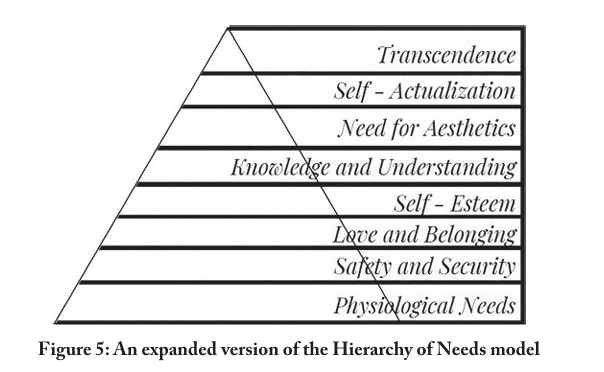
If you find yourself living in a box of needs, then you are in one of the boxes in Abraham Maslow’s pyramid of needs.


Pyramid of Needs

One must have a clear idea of one’s needs. However, desire is the thing that makes one get out of bed in the morning (especially, to go to work). To beat depression, one must desire something.

The desire for self-esteem is a paradox. We try to impress others with our material possessions and with how worthy they should think we are of their holding us in high esteem when the very need is for self-esteem, which only you can give to yourself.


Two modern-day issues with this area are:
1. Self-esteem is confused with social standing or status. This has to do with borrowed desires. They are the root of all misery. You can never enjoy their fruit, because the seed wasn’t yours, to begin with. If social media or peer pressure is the source of your desires in life, anxiety, stress and depression come free with it.


2. Not knowing what you truly want. Unless you take time with yourself to cut out everyone else’s desires that are filling you, your true desires will not surface. They are buried somewhere deep down along with your childhood memories.


While biological and psychological needs demand their fulfilment rather drastically, aesthetic needs are just as painful as all others when unfulfilled. Here, the dilemma is that it doesn’t look as important as a need, but it is an overwhelming personal need.


The desire for creativity, freedom and expressing authenticity and knowing the truth is the highest of human needs. Existential angst and the heights of anxiety about the unknown accompanied by the depression of not fitting in, not knowing how to evolve, confusion about truth and searching, without knowing what for, are the hallmarks of this stage. It is at this stage of our desire for deeper meaning that we feel most alone and at times lonely. This stage of anxiety and depression is a luxury. You get here only when the other levels of needs are satisfied and not escaped. Congratulate yourself if you are at this stage because desire takes on a whole new meaning from here.


Waking up to the meaning of desire from this stage we see it as a sign or force that rises within us to propel us in the direction of evolution, truth and destiny. Like all pure creativity, desire comes from a source beyond our limited perceptions of self. Then desire is seen as the fuel to unleash one’s true and individual potential. Desires are signs that lead to higher synchronicities, showing us the way to our higher self.


***

Get your copy of The Autobiography of God by Lenaa Kumar wherever books are sold.

Time for some tough questions with Deepak Ramola

50 Toughest Questions of Life invites people to have a conversation about themselves with themselves. Author Deepak Ramola’s quest began after he was inspired by the life lesson of a young girl who said, ‘Life is not about giving easy answers, but answering tough questions.’

Today we ask him some questions, to understand him and his journey a little bit better.

At what point did you decide to write a book with your experiences?

Last year, in February, while standing at the self-help section of a bookstore, I had an epiphany that most books were full of answers. I was curious to find out how people would respond to a book of questions. I had so many of them documented over the years, I started to give them shape and context for the book. I started writing in school for debates competitions and school magazine, I guess the seeds were sown there.

What is your favorite part about this book, and what was the most challenging question for you?

Front Cover 50 Toughest Questions of Life
50 Toughest Questions of Life || Deepak Ramola

Favorite part:

The stories that follow each question, encouraging people to put themselves at the centre of their life without guilt has been my goal with the book. I really love the story about the visually impaired girl who talks about the advantage of being blind along with the Mexican stories about the two trees of harm and healing.

Challenging part:

To keep it simple and honest. I was cautious to never over-impose my answers on to the readers but nudge them just enough to come up with their own. I had to go through a personal emotional roller-coaster with each of the 50 questions. Particularly reflecting on my toughest goodbye, how can someone make me feel loved was hard.

You started with around 500 questions, how did you come down to 50?

I followed my instinct on what seemed difficult to me and then, how people over the years responded to certain questions. I shuffled the list quite a bit with each draft. There are so many questions that I am yet to answer for myself, so I pulled them out in hope for a sequel to this book. Lastly, these 50 questions I feel are the ones we all need to answer collectively as the human race to be more kind and empathetic.

Who were the people that inspired these questions?

My mother never went to school but treated life as her classroom was a big inspiration for me growing up. Many questions emerged from our conversations. She taught me that literacy and education were two separate things and if we ask the right questions, we can educate ourselves beyond the infrastructure of curriculums. Apart from that Oprah Winfrey. Maya Angelou. Vishnu Kaushal. My team at Project FUEL. Interactions with Syrian refugees. My sister Deepika. And people I have learnt from and taught over the last 11 years. David Cooperrider once said, “We live in the world our questions create.”

What was the first question you ever wrote? And what is your next question going to be?

First question:

How would you introduce yourself with love?

Next question:

Have you ever given up on something beautiful and why?

If you are Facing a Burnout at Work (or ever have), this Article is for You

Almost all leaders go through a phase in their career where they feel demotivated, uninspired, lost and not on top of their game. This could be triggered by various internal and external reasons like lack of stimulation in their roles, misalignment of their goals versus the organization’s goals, resistance to unlearn and relearn, personal factors, and so on. If this phase is not addressed, it has a negative impact on the leader, his or her team and the organization. An uninspired leader cannot inspire others.

The purpose of this book is to give a name to this phase—leader’s block— and to help leaders recognize and acknowledge these patterns, and work on overcoming this phase and preventing derailment and burnouts.

Read what leaders have to say about their experiences of leader’s block.

  1. Karen, senior manager of a boutique risk consulting firm shared, ‘It was the time when I was really frustrated in my job and wanted to get out of it somehow, and when my prospective employer came with a fancy designation and lucrative offer I couldn’t resist. Looking back, that was a temporary fix, as that decision was not made with the right mindset or frame of mind. And I do regret it!’
  2. ‘I think my combative nature was probably new to me. I was not only defensive but also combative at work. It was one of the few times in my career when I took home very negative feelings. What you take home are the things you talk about, and if what you are talking about is all negative, you build up a significant amount of animosity towards the individual and environment.’- Frank, the executive vice president of a midsize energy company in Europe
  3. ‘It was not my usual style and the team expected me to behave as per my reputation of a fast executor. I was more circumspect during this time and there was a little uncertainty for everyone.’- Nancy, a senior leader at a fast-moving consumer goods (FMCG) company.
  4. The product head of a big technology major, said, ‘I feel that some of the structures or approaches that I took and some of the messages that I delivered were not allowing those around me to succeed, and it really stifled creativity; it became all about executing a plan and not about achieving excellence in the business. It created a culture where we were managing expectations versus excelling, not being transparent about our business and not being inclusive about how we managed our business.’
  5. ‘Honestly, I think externally nothing is visible, my team doesn’t see anything, they see me as engaged and focused, but that’s because this is a practised skill. The dilemma is inside, it’s all internal to me, and I wonder how much I am challenging myself intellectually and how much I want to learn something new. I feel like there’s a strong yearning in me to learn new things,’
  6. ‘The big disconnect was that I didn’t feel I was trusted or valued for my contribution. I felt that instead of positive reinforcement, there was more of a fear factor that was instilled in the relationship around performance. Those things, over time, drew energy away from me, and my inspiration and my commitment to my job at the time was probably less than optimal.’
  7. ‘My new role had a lot of personnel challenges where we performance-managed people. It’s never easy to fire someone. Even if you have done it before it’s hard. But if you haven’t done it before, it feels almost impossible. I had to make business decisions which had a direct and significant impact on the business and the people. That got me very nervous. I was leading a division of 300 people and the feeling of being watched closely was quite overwhelming! I started to doubt myself and felt totally blocked.’
  8. ‘My internal talk was am I being too neutral, am I not taking a stance? It was like my confidence was shaken. I also knew that I didn’t have the cover from either of my bosses, so I was constantly convincing both of them about what I wanted.’
  9. ‘I couldn’t believe I was doing this—I was snoozing my alarm a couple of times every morning and would refuse to get up till my wife would literally pull the covers off. My wife started to get worried; she thought I was not well. It felt like the days when I didn’t want to go to school. You wouldn’t think you would hear this from a senior vice president of a multibillion-dollar company.’
  10. ‘I felt as if one of my bosses was waiting for me to fail, so I had to constantly prove otherwise. I became quieter and more cautious as I didn’t want to be proven wrong, I was not being myself. It was affecting me personally, my confidence was shaken. I was afraid to try new initiatives or take risks as I didn’t want to fail.’

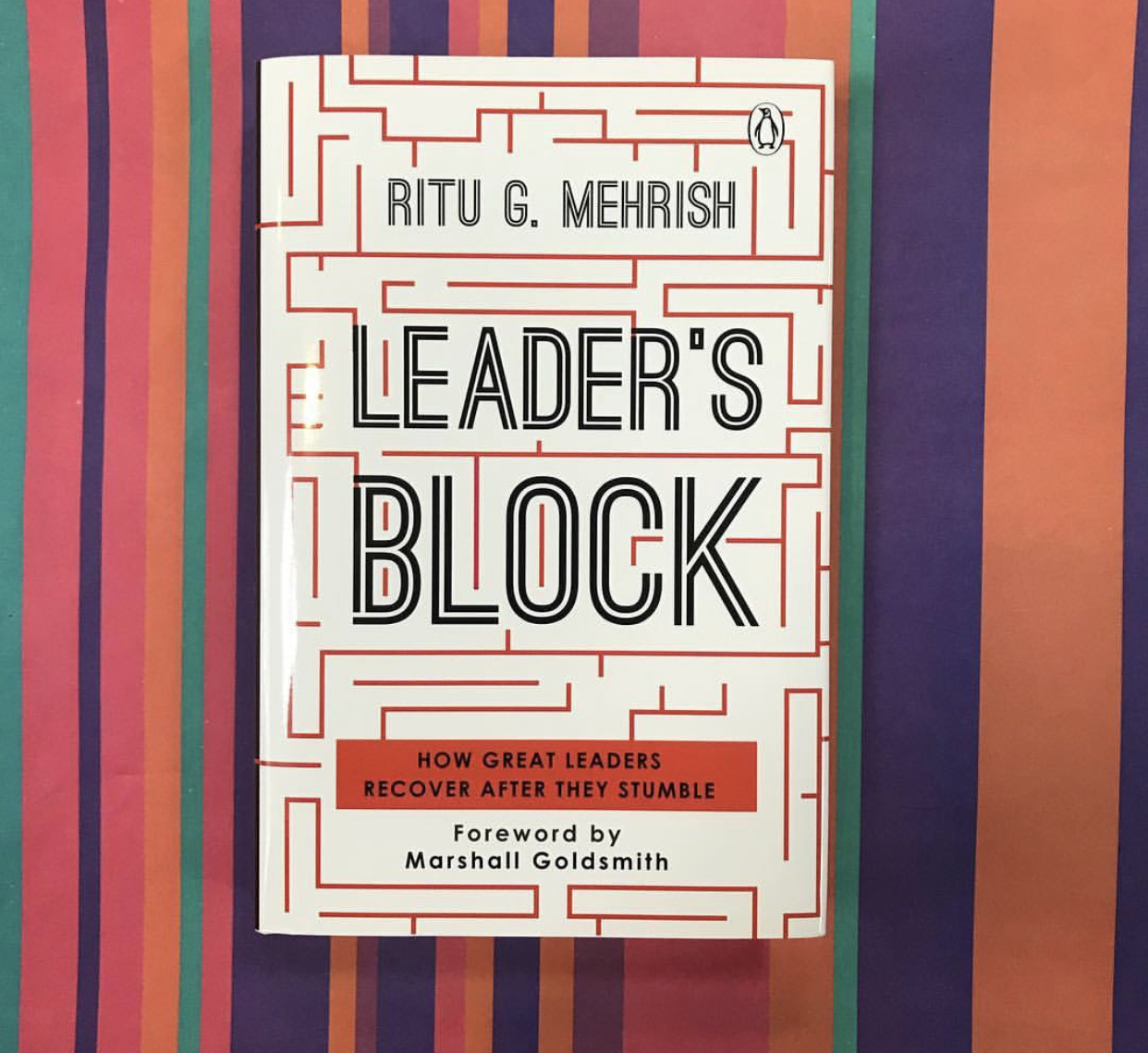
Identify when you are getting into Leader’s Block and learn how to break out of it in Ritu Mehrish’s book, Leader’s Block!

error: Content is protected !!