
Publish with Us

Follow Penguin

Follow Penguinsters

Follow Penguin Swadesh

Is Consumer India on the Brink of a Lifestyle Revolution?

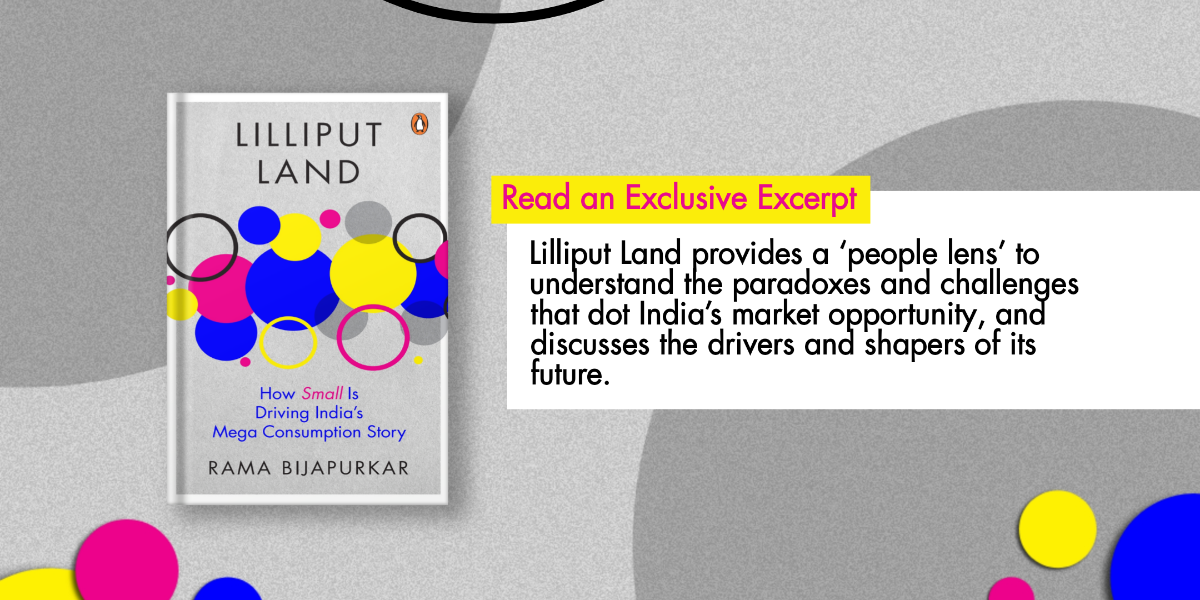
Discover the intricate world of consumer India in Lilliput Land by Rama Bijapurkar. Explore the aspirations and attitudes towards credit that shape consumer India’s behavior and learn through the many valuable insights for businesses navigating this dynamic market amidst India’s digital revolution.

Let the Mega Consumption story begin!


Lilliput Land
Lilliput Land || Rama Bijapurkar

***

A lot has been written about this in media stories and books, and ‘the changing Indian consumer’ is a favourite conference topic. However, given the structure story of the many Indias, all these anecdotes and observations of how different parts of the elephant behave need to be distilled into a holistic view of the nature of the beast. This chapter looks at key shapers of behaviour—aspiration, dignity, Indian identity, brand orientation, the phenomenon of monster consumers, how to understand and navigate heterogeneity of the market for strategy development, and how to read change in the confusing way in which Consumer India changes. Shapers of Consumer India’s Consumption Behaviour A macro-consumer view of the people of India Consumer India, as the previous chapter on structure has demonstrated, is a fragmented and complex hydra-headed monster, based on just its economy, demographics and living conditions. Add to that a layer of different social and cultural factors aff ecting diff erent parts of Consumer India (including community, region, politics and language), and diff erent levels of exposure to diff erent worlds outside, it gets even more complex. Requests asking me to speak on the topic of ‘Indian Consumer Behaviour’ or ‘Changing Consumer Behaviour in India’ terrify me. How does one capture the enormity of behaviour variations in Consumer India? No matter what one could say, the opposite would also be true in some audience members’ recent experience! Therefore, for reasons of both prudence and competence, this chapter will not attempt the near-impossible task of chronicling diff erent kinds of consumer behaviour and diff erent patterns of consumption.


The focus of this chapter will instead be on understanding the lives, mind spaces and attitudes that shape the behaviour of the people who comprise Consumer India. This is useful because consumption and brands do not live in the narrow confines of a market space but exist as a part of the larger canvas of  people’s lives. Serving a consumer base without understanding what makes it tick does not make for winning businesses, sound market strategies or creating brands that deeply resonate with consumers.


This chapter has three sections:
1. Shapers of Consumer India’s consumption behaviour: A few important themes that are common and relevant to all income groups.
2. Structure and drivers of heterogeneity in Consumer India and how to think about consumer segmentation.
3. How India changes and reading change in Consumer India.


As everywhere in this book, this chapter will also examine many of the commonly held hypotheses and theories about Consumer India to test their validity and change, nuance or caveat them as the case may require.


Section I:

Shapers of Consumer India’s Consumption Behaviour This section identifies and explores a few important themes that are common across all of Consumer India and shape the consumption behaviour of all income groups. A Tectonic Shift from Acceptance to Aspiration, Facilitated by Credit.


Aspirational India is a tectonic shift from the pre-liberalization days when we would often hear consumers of lower-income groups tell us in focus groups, ‘This is not for me, this is for the badey log (big people).’ Now, there is a strong statement of, ‘I want to have something like that, be it products or experiences.’ A car is obviously not affordable, but a bike and a taxi for special family outings is. Now, having what celebrities have has become easy with social media. Copies of actress Alia Bhatt’s mehendi pattern and cheap knock-offs of her wedding dress are available. Influencers and beauticians of every social class tell you how to use make-up like celebrities do and style yourself at a price point that you can afford. As ad man Santosh Desai puts it, the big shift is that ‘life is not a condition to be endured but a product to be experienced’. Aspiration-led living is the opposite of the way it used to be. The attitude and mindset shift is from ‘this is what I have and how do I manage best within it’ to ‘this is what I want, so how do I manage to get it’. We see this resulting in choices which can best be described as ‘stretch for more, do not settle for less’. Borrow and buy the higher category car or two-wheeler or buy a second-hand one rather than settle for the easily affordable small car, even if it means waiting a bit, buying a pre-owned vehicle or taking a loan.


Credit or borrowing for consumption once considered a very dangerous thing, is now acceptable and ‘normal’ to Consumer India. Amazon and consumer durables stores and travel sites helpfully ask you, at the time of checking out, if you want to pay by EMI, that is, equated monthly instalments of credit. Credit is also morally purified. Its cultural label has changed from indebtedness, which can lead to ruin, to being the working capital for life and the helping hand that everybody needs to reach their goals. Financial services companies have been exploiting this attitude shift leading to the regulators and the courts coming down hard and framing laws to curb irresponsible lending that leads to imprudent borrowing, and strong-arm tactics for recovery that lead to customer stress and even suicides. An example of this is what happened to the microfinance industry in 2010 leading to a new law in 2011 that banned MFIs from approaching the doorstep of their customers, lengthened the loan collection cycles and told lenders that they had to get government approval to give a second loan to the same lender. The Reserve Bank of India, India’s banking regulator has issued a charter of customer rights for banks and non-banking financial services companies (NBFC) that includes the ‘right to suitability’, where ‘only products and services that are appropriate to the understanding and financial conditions of the customers may be offered to them.’ It is a caveat venditor (let the seller beware) as far as enforcing this right is concerned.

***

Get your copy of Lilliput Land by Rama Bijapurkar wherever books are sold.
From Bottom of the Pyramid to the ‘Middle of Diamond’​

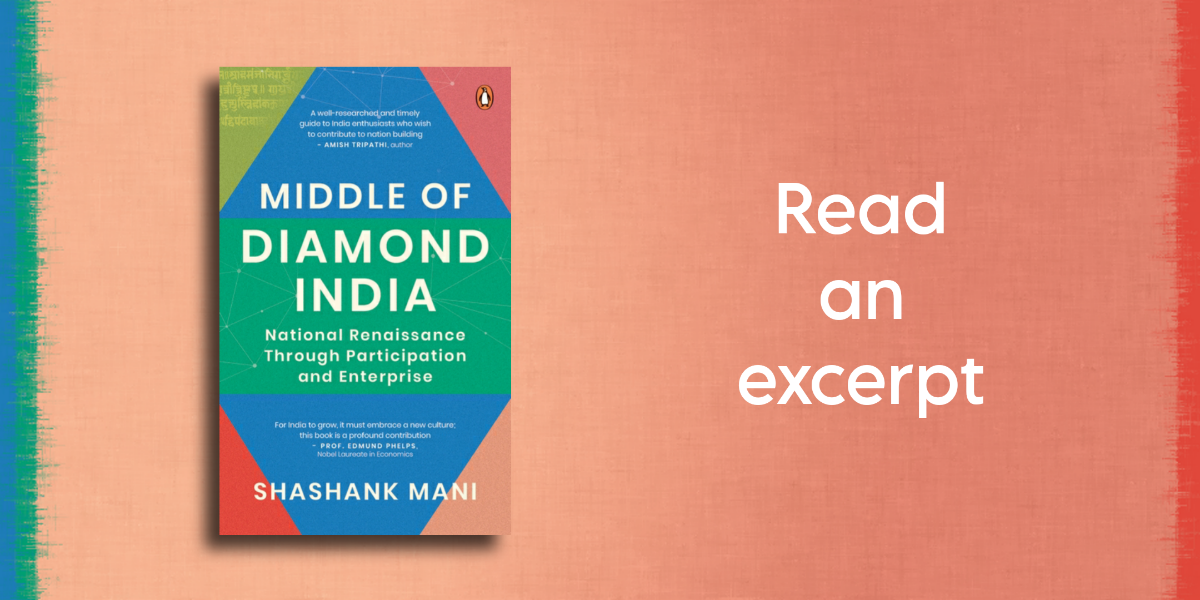
In his new book, Middle of Diamond India writer Shashank Mani talks about a big change happening in India. As India celebrates its seventy-fifth anniversary of being independent, something important is taking place. Instead of only big cities and rich people being the focus, more attention is going to people from smaller towns and areas. These folks are often called the “middle class.” This change is different from before when we mostly noticed the rich and the poor, reshaping the conventional pyramid analogy into a more encompassing and multifaceted diamond-like structure.

Read this insightful excerpt to know more about what Middle of Diamond truly means.

Middle of Diamond India
Middle of Diamond India || Shashank Mani

***

Morphing a Pyramid to a Diamond


As India crossed its seventy-fifth anniversary of Independence, this upsurge has picked up pace. Those from Tier 2 and 3 districts, such as Ahmednagar or my native Deoria, are now in the majority and asserting themselves. The aspirations of this segment are on the rise. The language barrier remains—Indian languages and hesitant English versus the annexe-honed English of the cantonment or a metro. But the centre of gravity has shifted firmly to this segment in the middle. This new centre will define the political, social, cultural and economic trajectory of the country over the coming twenty-five years.


In a paper published in 2002, C.K. Prahalad and Stuart Hart, two renowned management professors, came up with the phrase ‘Fortune at the Bottom of the Pyramid’. Prahalad expanded this theory into a book,1 which described the emerging market demography as a Pyramid. It invited corporates to search and seek a fortune at the Bottom if they made goods and services to appeal to people with lower incomes and cash flows.


About a decade ago, analysts began to sense that this reality was shifting with the emergence of the Middle. A 2010 World Bank report divided the 7 billion of the world’s population into four broad categories of countries. There were countries with a population of about a billion where per capita GDP was above $12,000. Another one billion lived in countries where the per capita GDP was between $4000 and $12,000. A third group of countries, to which India belonged, had a population of 4 billion and a per capita GDP range of between $1000 and $4000. Finally, one billion people lived in countries with a per capita GDP below $1000.2 The vast majority—four billion—were in countries in the Middle. As the number of people in extreme poverty fell sharply, the vision of the world as a Pyramid, with a small number of elites gazing down at the poor from their perch at the top, was getting outdated.


Middle of Diamond ImageOver the past decade, that ‘emerging middle’ has risen further, consisting of 800 million Indians and shaping countries like India into a Diamond.
 

If we look at an economic classification of India in 2020, it had approximately 200 million Indians at the top with an average per capita GDP of Rs 4 lakh per year, or $5000, which in PPP terms is close to $15,000 per capita. The bottom segment consists of 400 million Indians, with a per capita income of Rs 80,000 per year or $1000, which translates to $3000 in PPP, poor even by sub-Saharan standards. The remaining 800 million people comprise the ‘emerging middle’ with a per capita income of Rs 1.5 lakh or $2100 per capita, which translates to $6000 in PPP terms, now a clear majority. The top of this Diamond-shaped India earns 2.6 times more than the middle and almost five times more than Bottom. These numbers are averages, with each segment having higher and lower incomes. What the world calls Indian ‘middle class’ resides mostly at the bottom end of the Top. The vast majority of those in the Middle are ‘emerging middle class’, or simply ‘Middle India’. Middle India has around 800 million people, 11 per cent of the global population. On a PPP basis, the Middle has, on an average, a GDP that is the same as the whole of India, at $6000 per capita in PPP terms.


Middle India can also be broadly located in the 750 districts that make up our country. Each district will have some proportion of the Top, Middle and Bottom segment, but if we take an average classification, a diamond shape emerges here too. The top segment resides in thirty metro and Tier 1 districts, such as New Delhi, Mumbai, Kolkata, Chennai, Thane, Gurgaon and others, and on average coincides with the top income segment. When I studied at Modern School, Humayun Road, I was rubbing shoulders with the children of these Indians. These districts have approximately 160 million Indians, and in the main, they are prosperous. On the other extreme are 470 Tier 4 districts where 460 million Indians live, largely coinciding with the bottom income segment. These districts are smaller in size and on average are still poor, such as the district of Dhemaji in Assam or Gadchiroli in Maharashtra. Sandwiched between these two segments are 240 districts classified as Tier 2 and Tier 3 districts where 780 million Indians reside—57 per cent of India’s population, in places such as Allahabad in UP, a Tier 2 district, or Ahmednagar in Maharashtra, a Tier 3 district. The US, that other large democracy, also witnessed a similar morphing after the Second World War as expressed by Edward Humes, ‘After the war, economic distribution in the US began to resemble a diamond, relatively small number of poor and rich at either end, with a big fat middle at the centre.’ The post-Second World War growth of the US was also powered by a similar shift.


***

Get your copy of Middle of Diamond India by Shashank Mani wherever books are sold.

Forces: consolidation of a rajasic India

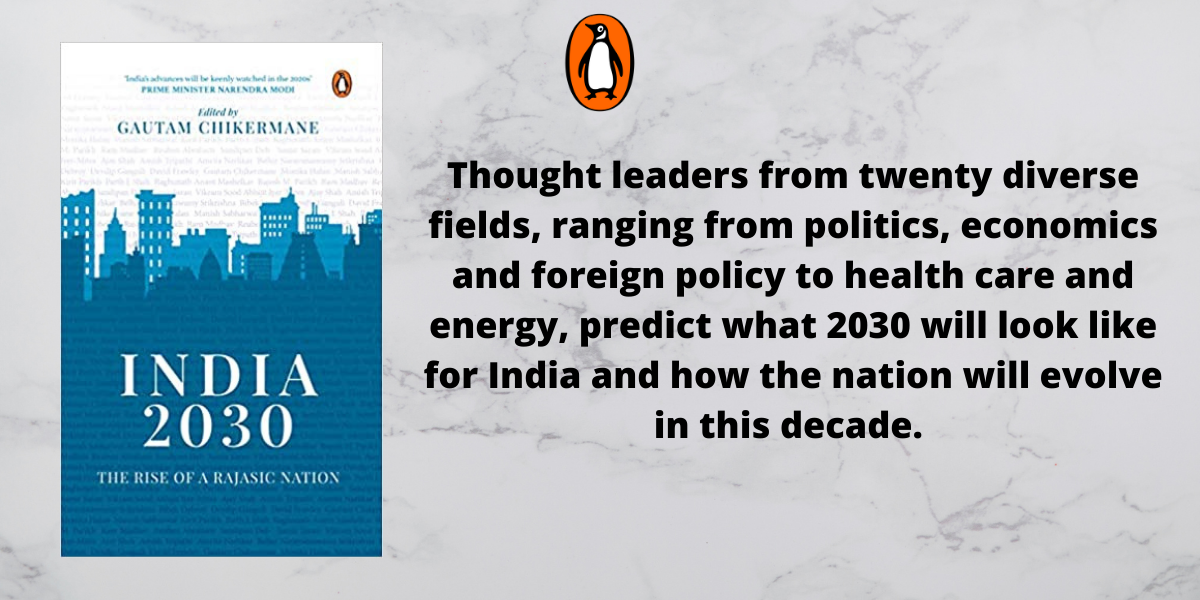
Thought leaders from twenty diverse fields, ranging from politics, economics and foreign policy to health care and energy, predict what 2030 will look like for India and how the nation will evolve in this decade.


Editor Gautam Chikermane has masterfully weaved together essays by Abhijit Iyer-Mitra, Ajay Shah, Amish Tripathi, Amrita Narlikar, Bibek Debroy, David Frawley, Devdip Ganguli, Justice B.N. Srikrishna, Kirit S. Parikh, Manish Sabharwal, Monika Halan, Parth J. Shah, Raghunath Anant Mashelkar, Rajesh Parikh, Ram Madhav, Reuben Abraham, Samir Saran, Sandipan Deb and Vikram Sood into a single volume that looks towards India’s future.


India 2030 | Gautam Chikermane


Here is an excerpt from the book India 2030-


Beyond all other transformations in India, the 2020s will see a rajasic reawakening of the nation. This dynamic surge in the country’s soul will be driven individually, one citizen at a time; it will articulate its self-becoming as a coming together of India’s collective soul. Its manifestations will be physical and mental, its driving force spiritual. Supported by a political leadership that is in tune with the soul of India, Bharat, this change began in the 2010s. It will consolidate in the 2020s and reset the material destiny of India in the 21st century.


It will create a new balance between two forces. First, a centripetal force that will concentrate the energies of India to the principles of its nationhood, be informed by its own intellectual traditions and expressed through a modernity rooted in its soul. And second, a centrifugal force that will expand its footprint outwards, through a deeper and stronger engagement with civilised nations going hand in hand with a self-assured confidence that will keep a check on barbaric powers on its borders.


The 2020s will be a decade of transition. The transition will impact every aspect of India – its psychological approach, its democratic institutions, its diverse people, its global engagements. The shift will impact individuals, bind them, it will be powered by them and will simultaneously serve them as a collective. It will be a time when the very life force of India will be in constant motion towards a new equilibrium that will take inspiration from the nation’s swabhawa (essential character or spiritual temperament) in order to follow its swadharma (express its true essence).


Ten Priorities India Should Focus On

Bimal Jalan had a close view of financial governance while he served as Union Finance Secretary and Governor of the Reserve Bank of India. Drawing on his vast experience he compares two distinct periods: 1980–2000 and 2000–15, and examines the transition India has made in the last four decades from a strictly regulated, slow-growth state enterprise to one of the fastest-growing economies in the world.
In his latest book, India: Priorities for the future he lists out few areas India needs to pay attention to.
Here is a list of ten of those priorities:
One of the foremost priorities regarding financial governance
Creative - 1.png
Priority for the banking sector
Creative - 2.png
Another reform in the financial sector that the India has to bring about
Creative - 3 (2).png
The RBI has to keep working with financial experts to develop procedure for the debt markets to grow
Creative - 4.png
The outcomes of the present schemes in terms of actual benefits is pretty low
Creative - 5 (1).png
Performance reviews of a ministry will lead to better execution of policies
Creative - 6 (3).png
Red tapism needs to be done away with
Creative - 7 (2).png
Outsourcing to different agencies reduces petty corruption and delays
Creative - 8 (1).png
An urgent political reform is to speed up investigations of persons who are in political parties
Creative - 9 (1).png
An utmost priority lies in making the states accountable for policy execution than the Centre
Creative - 10 (1).png
Which priority according to you should be the India’s topmost priority? Tell us.
Footer (1).png

India Transformed — An Excerpt

Rakesh Mohan is the former deputy governor of the RBI. He has also served as the executive director of the IMF and secretary, Department of Economic Affairs, and Ministry of Finance. He is currently a Distinguished Fellow with Brookings India.
India underwent a major economic reform in the form of liberalization in 1991. In India Transformed, India’s top business leaders and economists come together and provide a balanced picture of the consequences of the economic reforms, initiated in 1991. They ask themselves some imperative questions: What were the reforms? What were they intended for? How have they affected the overall functioning of the economy?
Here is an exclusive excerpt from the foreword of the book, written by Strobe Talbott, the former Deputy Secretary of United States of America.
This timely, authoritative and policy-relevant volume sheds light on India’s dramatic changes over the past quarter century. That transformation has not only been a boon to the people of India, it has also contributed to the progress of the human enterprise as a whole. The world’s largest democracy is a major player on the world stage. It is certainly viewed and valued that way by my own country, the United States of America.
The economic and commercial dimension of India’s evolution is, of course, crucial. Hence, the focus of submissions in the pages that follow is political economy, financial development, trade and globalization, technology and innovation, agricultural and industrial development, and the interaction between the private and public sectors. The contributors include some of the original designers and implementers of the reform process, along with the prominent business leaders who have been the most successful builders of the economy.
There is also, thanks to the inclusion of wisdom from Shivshankar Menon, Shyam Saran and Sanjaya Baru, due attention paid to India’s foreign and security policy.
Over the course of the last half-century, I have had numerous opportunities to watch India’s evolution, first from the vantage point of a student of international relations and then for two decades as a journalist. During my eight years in government during the 1990s, I also had a chance to participate in the effort by the Indian and the US governments to put the bilateral relationship on a sounder—indeed, a transformed—footing than had been the case in the first four decades after Indian Independence. Dennis Kux captured the perception on both sides of that star-crossed backstory in the subtitle of his 1992 book, India and the United States: Estranged Democracies.
What stymied a robust bond between these two countries? After all, both had wrested their independence from British rule while adopting and adapting many of the features of British constitutional governance (minus, of course, the monarchy).
The key factor, I’ve always believed, was the Cold War.
It was approximately at the midpoint of that global schism that I first visited India forty-two years ago. I owe that enriching and informative experience to a glitch in my career as a Sovietologist.
In those days, I was a reporter for Time magazine concentrating on East–West relations and was assigned to the State Department beat. This often meant whirling around the world, coping with what seemed like a permanent case of jetlag, trying to keep up with the then secretary of state Henry Kissinger.
In October 1974, Kissinger embarked on a seven-nation diplomatic tour starting with Moscow. The Kremlin was eager to welcome the secretary of state as the personification of continuity in the US policy of détente, in the wake of Richard Nixon’s resignation and Gerald Ford’s ascension to the presidency. The Soviets, however, were not about to extend their hospitality to me. I was persona non grata because of my role in translating and editing Nikita Khrushchev’s memoirs. The material for the two volumes was surreptitiously recorded and spirited out of the country while he was under virtual house arrest, since his ouster from the leadership ten years before. The second volume, published earlier in 1974, particularly irked Foreign Minister Anatoly Gromyko, who sent a message to Kissinger’s plane over the Atlantic, denying me a visa.
After I was unceremoniously dropped off in Copenhagen during a fuelling stop, I hopscotched to New Delhi, which would be Kissinger’s second stop after Moscow.
On the personal front, my several days of free time were immensely gratifying. I made friendships that lasted for decades. I also came to know Ambassador Daniel Patrick Moynihan (whose desk officer at the State Department was none other than Dennis Kux). Moynihan’s wife, Elizabeth, took me under her wing and drove me out to—where else?—the Taj Mahal, where she was already deeply into studying the Mughal gardens.
Blog-Footer.jpg

The Ups and Downs of Narendra Modi’s Governance

Uday Mahurkar in his latest book Marching with a Billion takes stock of Narendra Modi’s three years in power. Focusing on key areas of governance like infrastructure, foreign affairs, finance, digital technology, etc. Mahurkar showcases the work of the present government and the monumental changes the prime minister has brought about.
Here are ten highlights of Narendra Modi’s tenure:
Nearly 27 crore poor people opened their bank accounts under Narendra Modi’s Pradhan Mantri Jan-Dhan Yojana.
Blog Creative 1.png
Uday Mahurkar points out that India has emerged as the number one global destination for FDI because of these two factors.
Blog Creative 3.png
There have been disputes going on between investors and shipping ministry on account of the retrospective regulations slapped by the A.B. Vajpayee government fifteen years ago.
Blog Creative 4.png
Uday Mahurkar notes that the relationship Modi is forging with the US, cutting across that country’s web of diplomatic calculations, is also new in the history of India’s diplomacy. The way Modi capitalized on India’s strength during his June 2016 US visit, which took the US Congress by storm and instilled the fear of isolation in the heart of Pakistan, and even China, left the world powers impressed.
Marching with a billion blog 01
Modi’s government is probably the first since Independence that has made a real attempt to involve the people in the process and, that too, quite successfully.
Marching with a billion blog 02
Modi, who has always been ahead of his times in adopting the latest technology, told the officials that he wanted to link people to digital technology like nowhere else in the world.
Marching with a billion blog 03
One big criticism of the government on reforms is what many people call its failure to disinvest big PSUs like Air India, SAIL and CIL. There is a view that taxation and banking reforms could have been faster. Mahurkar quotes a senior BJP leader with sound knowledge of the Indian economy who says: ‘What was needed was a transformational approach on reforms, but many steps indicate the government’s approach has been selectively incremental.’
Marching with a billion blog 04
Mahurkar observes that Modi’s China diplomacy signals a great change in India’s attitude towards that nation—from a defensive posture maintained over several decades to that of equal, controlled aggression. Modi gave another sign of India’s new stance soon after the G20 summit in the way he chose to react to the China–Philippines dispute in the South China Sea at the summit of the Association of Southeast Asian Nations at Laos.
Marching with a billion blog 05
According to Uday Mahurkar, the prime minister believes that the country has to overcome the urban–rural digital divide if it is to move forward.
Marching with a billion blog 06
Uday Mahurkar points out that there have been projects under Nitin Gadkari, Minister of Road Transport and Highways of India in Modi government, which have not taken-off yet.
Blog Creative 5
Tell us what you think of Narendra Modi’s governance in the past three years.
Blog Footer

error: Content is protected !!