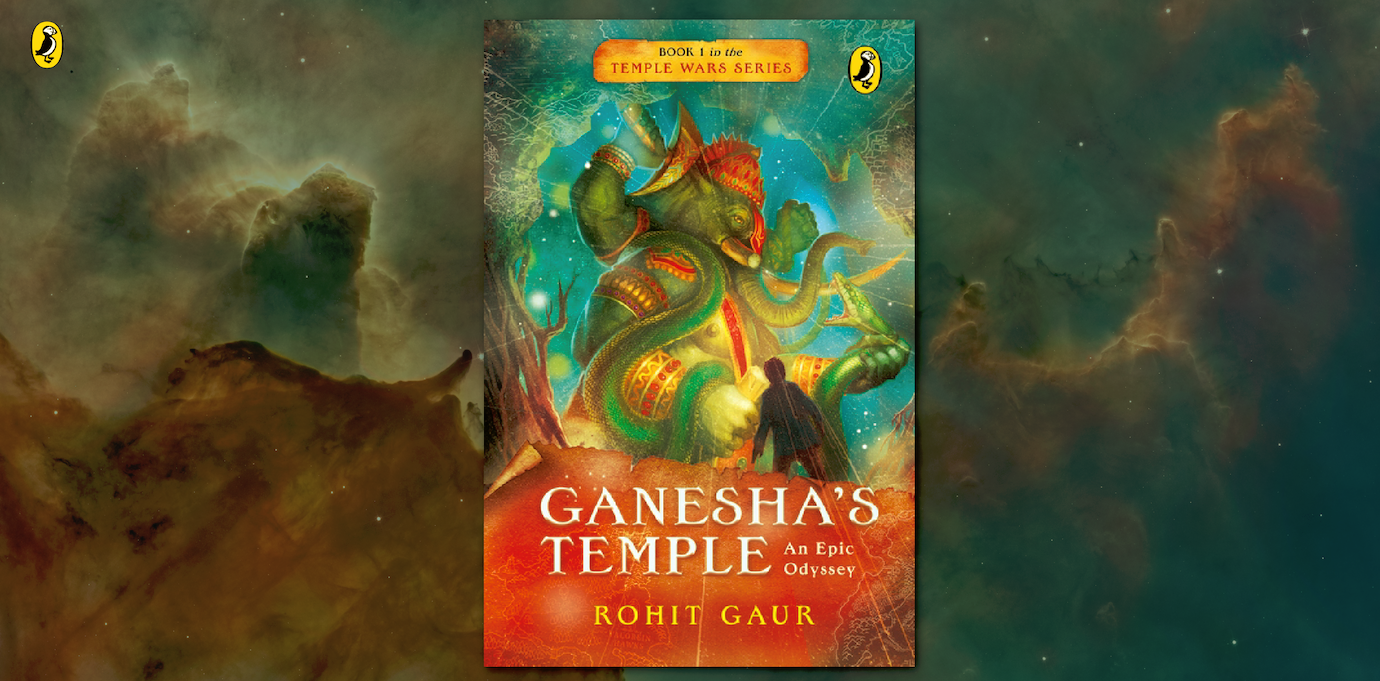
Not a lot is going right for Taran Sharma. First, he stole his annoying brother’s necklace and ran off into the night. Then, his family got taken hostage by spindly creatures of the dead. And to top it all, he’s just been charged with a mission by Lord Ganesha himself! Now, in order to rescue his family from the hands of the preta, he has to undertake a journey more fantastical than he can begin to comprehend.
As Taran embarks on an epic voyage that may lead to disastrous consequence, he realizes that having faith, especially in himself, might be harder than he was led to believe.
Dive into a riveting adventure to the Veiled Lands, replete with evil Naga armies, mythical creatures and a supervillain who will stop at nothing to reach the elusive Gateway of Moksha in Ganesha’s Temple.
**
Ganesha closed his eyes and raised all four of his hands. Particles of light appeared from thin air. They formed images in the centre of the room, and then began shimmering, swirling into new images. Taran saw human figures eating, dozing, bathing, riding horses.
‘Many thousands of years ago, gods and goddesses ruled happily over a vast world called the Veiled Lands. It was a spiritual world filled with an energy that forms the spiritual core of all life. We call this prana.’
Ganesha focused his kind, brown gaze on Taran.
‘The Veiled Lands are very simply an old earth, and its beings as old as this world itself. They have seen endless cycles of destruction and rebirth, existing far longer than you can imagine.
Ganesha’s Temple || Rohit Gaur
‘In the Veiled Lands, through prana, came the first beings of light and dark—a duality exists wherever life forms. Dyaus the Sky Father and Prithvi the Earth Mother created Shiva, Brahma and Vishnu, as well as many other devas like Surya, Agni, Indra, Varuna. These devas went on to create spirits and magical creatures, who lived peacefully together. Some devas turned into asuras, who are demons and titans. I could go on for years if I had to narrate the lives of every single deva and asura.’ Ganesha waved his hand as though turning a page in a book.
From the light particles over Ganesha’s head, new images appeared. One of the figures, snake-like and menacing, was pictured standing over a fallen deva, a staff raised above his head. Taran stared in fascination.
‘Vritra,’ Ganesha said soberly. ‘Once a deva, Vritra grew ambitious and power-hungry and sought to conquer his brethren. He attempted to overthrow the peaceful order, dominate the other devas and asuras, and rule the Veiled Lands by himself.
‘His rebellion was unsuccessful and the other devas, pitying their brother for his vanity, vowed to exile him from the Veiled Lands. They decided to create a parallel world for asuras like him, which lacked all prana. They had to combine all their powers in order to create such a world, and that powerful spell also created the Bare Lands—the world you now inhabit, Taran.
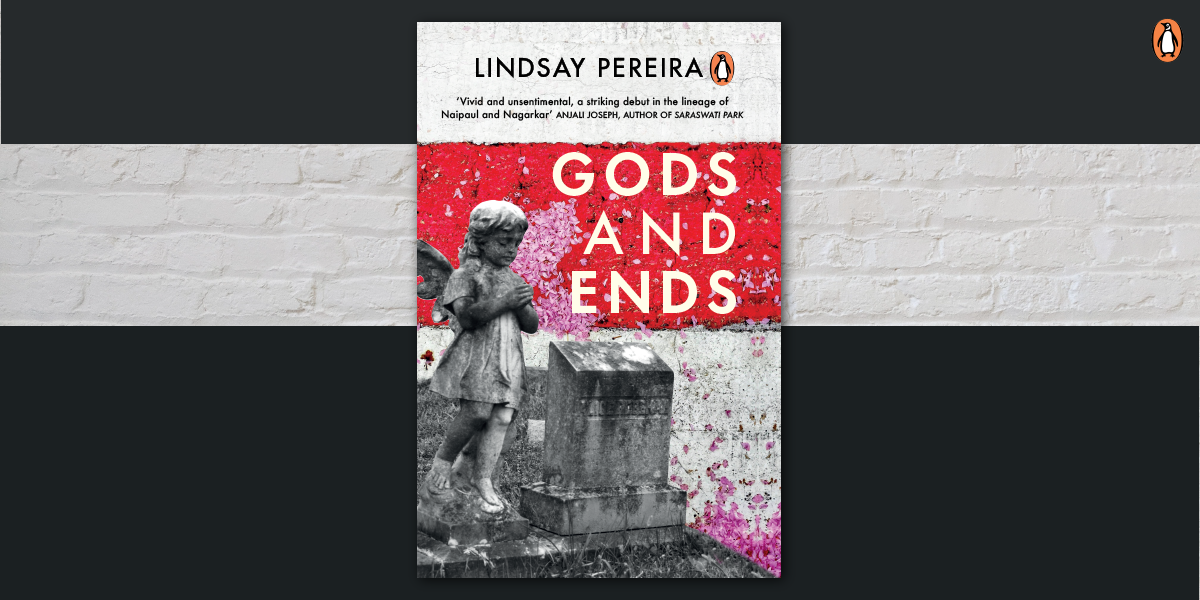
Philomena Sequeira knows what she wants by the time she turns fourteen. Her father wants something else. Her neighbours deal with adultery, abandonment and abuse, by hoping for a place in heaven.
Life is unyielding for the tenants of the rundown Obrigado Mansion in Orlem, a Roman Catholic parish in suburban Bombay. They grapple with love, loss and sin, surrounded by abused wives and repressed widows, alcoholic husbands and dubious evangelists, angry teenagers and ambivalent priests, all struggling to make sense of circumstances they have no control over.
Gods and Ends takes up multiple threads of individual stories to create a larger picture of darkness beneath a seemingly placid surface. It is about intersecting lives struggling to accept change as homes turn into prisons. This is a book about invisible people in a city of millions, and the claustrophobia they rarely manage to escape from.
**
The well appeared to have been there forever, sunk into the earth at a time when there couldn’t have been too many people around to use it. And yet, as any careful observer might have noticed, it had once been cared for, its sides carefully scoured, solid stone steps marking circles as they disappeared into its gloomy depths. Until the outer wall collapsed, sliding slowly into the murky green water, there may have been a few informal meetings held nearby. Some of the early residents of Orlem may well have stopped to chat around it on sunny mornings, to discuss dissolute husbands or the latest scandal from the goan villages they came from, while stooping down to draw water.
On the night of 24 December, only one voice was heard. It was between 1 and 2 a.m., and the water lay undisturbed, its opaque surface broken only by lethargic leaves slipping, sliding, gliding down from laburnum trees looming darkly above and around the well. The only other sound came from an unsteady stream of urine pattering down, over the ruined edge, through a space where the wall once stood.
Gods and Ends || Lindsay Pereira
‘Come from England, come from Scotland, come from Ireland,’ the voice slurred tunelessly. ‘Looking out for a pleasant holiday? Come to Bombay, meri hai.’
Jude Sequeira pissed his cares away. He was dimly aware about urinating into a source of drinking water for some of his neighbours, but was too drunk to care. The half bottle of cheap whisky he had consumed lay volatile in his stomach, warming him, while making his head swim ever so gently. The song he was singing continued to pour out of him, its lyrics a jumble. After singing it twice, he looked up and stopped in awe. Above him, in a hole cut out through the trees that formed a canopy, a few stars twinkled brightly. He couldn’t remember the last time he had seen stars.
Smiling to himself, he shook his penis half-heartedly, the last few drops wetting his toes. As he tried to zip up, something caught his eye. A mouse? A cat? Swaying slightly, he turned. There was a sudden moment of clarity when he recognized the figure standing before him. His lips moved as he struggled to articulate something that seemed to be just out of reach. Teetering for a few seconds, suddenly on the brink of sobriety, he slipped. The splash echoed briefly before receding into the night. The waters closed over, stifling a scream before it reached his throat. As he went down, Jude found the name he was looking for.
On the ground above, all that remained were his slippers: a pair of grimy Bata chappals, their blue straps long faded. In time, a milky sun rose, its appearance heralded by noisy sparrows.
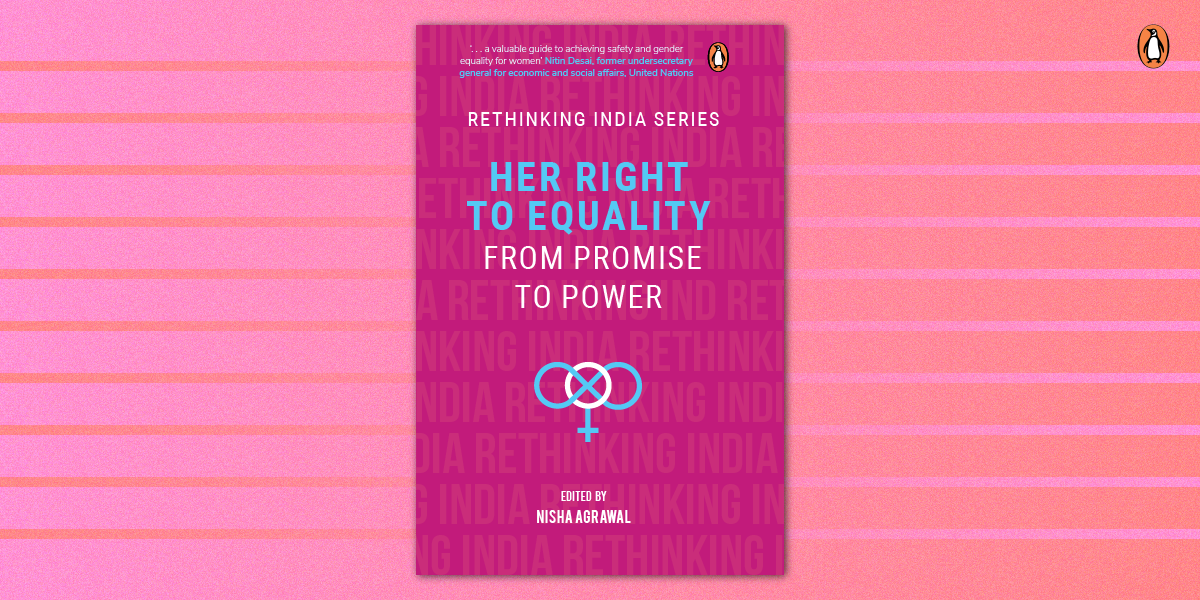
Promises of gender equality and justice have been made, repeatedly. They have failed repeatedly. The roots of misogyny form the foundations of our civil society, and the essays in Her Right to Equality raise crucial questions about the status of gender equality in our country. It scrutinizes institutions that are meant to safeguard the rights of women and minorities, and sheds light on the colossal amount of work that needs to be done. This is an excerpt from the volume:
A great deal of focus in this discussion is on the decline. However, an equally (if not more) important issue is the persistently low level of women’s LFPR in India, lower than our other South Asian neighbours, Bangladesh and Sri Lanka. In joint work with Naila Kabeer, we explore factors that shape the low level. Our results are based on a large primary household survey in seven districts in West Bengal. We collect data on all the indicators included in the official surveys, and on additional variables that are usually not included in surveys. Since we wanted to focus on which specific internal constraints inhibit women from working, we asked specific questions on whether they were primarily responsible for childcare, for elderly care, for standard domestic chores (cooking, washing clothes, etc.), and if they covered their heads/faces always, sometimes, or never. The latter is taken as a proxy for cultural conservatism; indeed, internationally, the fact of women covering their faces in public spaces is often criticized as an oppressive practice. Of course, the context in the West is different in that covering heads/faces is associated with being Muslim. In India, the practice is followed by both Hindus and Muslims, and in recognition of that, we label it more broadly as ‘veiling’, and not as wearing a burqa or hijab. We implemented simple changes to the official survey questionnaires in order to get better estimates of women’s work that lie in the grey zone. Accordingly, our estimates are higher than official estimates, but even with improved measurement, a little over half (52 per cent) get counted as ‘working’. Which means that participation in work is low, even after work in the grey zone is included.
The Critical Role of Domestic Chores
Her Right to Equality||Nisha Agrawal
We then investigated the main constraints to women’s ability to work. Our main findings were that women being primarily responsible for routine domestic tasks such as cooking, cleaning and household maintenance, over and above the standard explanations in the literature (age, location, education, marriage and so on) as well as elderly care responsibilities, lowers their probability of working. If domestic chores emerge as an important determinant of women’s labour force participation, after controlling for the standard explanatory factors, the question that arises is this: to what extent do the low LFPRs found in India in particular, but in South Asia and MENA (Middle East and North Africa) countries more broadly, reflect international differences in women’s involvement in housework? There is some indicative evidence that indeed, in these regions, women spend more time on unpaid care work, broadly defined (including care of persons, housework or other voluntary care work), relative to a range of other developing and developed countries in the world. According to OECD (Organisation for Economic Cooperation and Development) data, in 2014, the female-to-male ratio of time devoted to unpaid care work was 10.25 and 9.83 in Pakistan and India respectively—the two countries with the lowest female LFPRs within South Asia—compared to 1.85 in the UK and 1.61 in the US. Factors traditionally viewed as cultural norms that constrain women’s participation in paid work, such as the practice of veiling or adherence to Islam, are insignificant in our analysis after the conventional variables have been accounted for. Given that the primary responsibility of domestic chores falls on the woman, we suggest that the conventional definition of cultural norms needs to be revised and shifted to focus on the real culprit, viz., the cultural norm that places the burden of domestic chores almost exclusively on women.
Is There an Unmet Demand for Work?
Do women really want to participate in paid work, or have they either internalized the male breadwinner model which relegates them to take care of the home and the family? What about the ‘income effect’, according to which women work only if necessary for economic reasons, and withdraw from work as soon as they don’t need to? What about the marriage penalty, that is, women dropping out of the labour force once they are married? Thus, women’s work might be a sign of economic compulsions of trying make two ends meet rather than an expression of their desire for economic independence. We explore the evidence for this in our survey. Married women are less likely to be working than unmarried women, but marriage in India is near universal (making marriage the most common career choice for women), and asking women to choose either marriage or paid work is not a fair or realistic choice. We asked women who were currently not working if they would accept paid work if it was made available at or near their homes; 73.5 per cent said ‘yes’. When questioned further, 18.7 per cent expressed a preference for regular full-time work, 7.8 per cent for regular part-time work; 67.8 per cent for occasional full-time work and 5.78 per cent for occasional parttime work. It would appear that there was indeed a major unmet demand for paid work, whether regular or occasional, full-time or part-time, as long as the work in question was compatible with their domestic responsibilities. Based on this, we suggest that being out of the labour force is less a matter of choice for large numbers of women, and more a reflection of the demands of unpaid domestic responsibilities.
~
Her Right to Equality is an urgent and meticulous study of how far we have come in terms of gender justice, and how far we need to go.
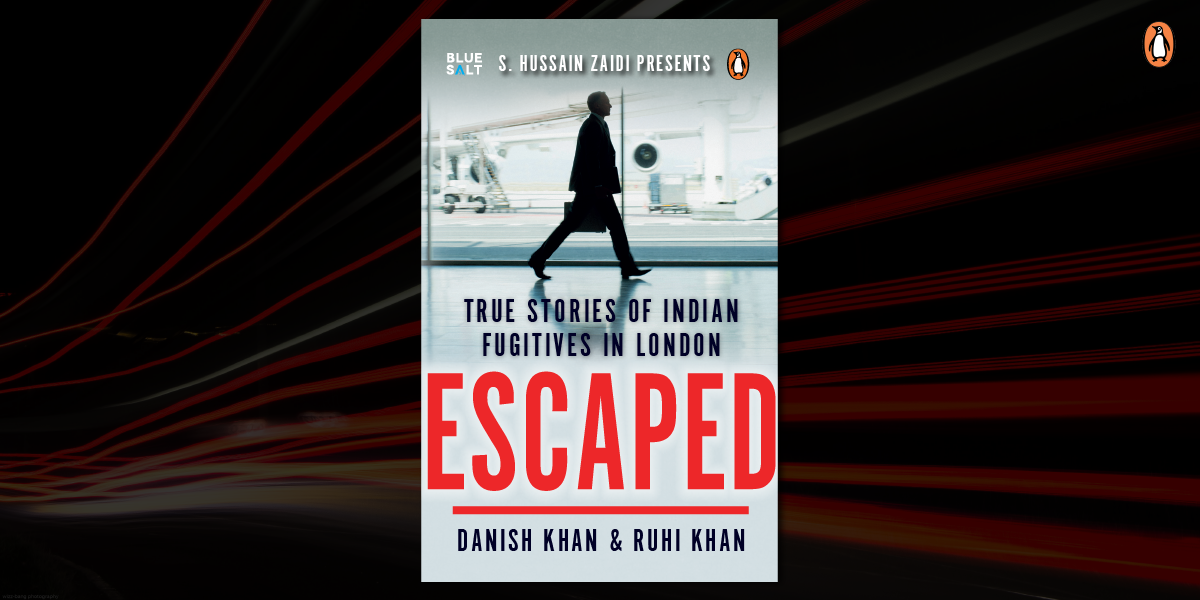
While much has been read and said about Vijay Mallya and his constant hide-and-seek with government authorities, details remain either inaccessible or too obfuscated. Escaped is a deep dive into the deeds and misdemeanours of the magnate, and what lies beneath the scaffolding of a billionaire-gone-wrong. Here is an excerpt:
The more famous pad of the Mallyas is the palatial country house in Tewin village, Hertfordshire, 20 miles north of London. The quintessential English village dates back to the Anglo-Saxon times, boasts of a picturesque countryside rich in flora and fauna and has a population of barely 2000.
Mallya’s property Ladywalk was previously owned and occupied by Anthony Hamilton, father of F1 champion Lewis Hamilton, and hence has always been the cynosure of all eyes in the sleepy village.
Though not much is visible from the main entrance, a public footpath runs around the property, providing an unrestricted view of the enormous spread that includes the main house Ladywalk and a lodge called Bramble Lodge with plenty of land for Mallya’s five dogs — Bichon lapdogs Elsa and Daisy, golden retrievers Luna and Bella and a St Bernard called Spirit — to play chase.
Security at Ladywalk is a priority and several CCTV cameras are in operation 24×7 at various entry and exit points along the periphery of the extensive property. Guards, dressed in black and armed with iPads and binoculars, are ever vigilant, and more so for snoopy scribes.
The large modern house sits on 30 acres of land and boasts of swimming pools, tennis courts and several outhouses. The two-year renovation of the property saw a continuous flow of architects, landscape artists, builders and gardeners. But what the locals most look forward to is the plethora of supercars that take to the narrow roads leading to Queen Hoo Lane. A sure sign that the party king is at home!
Escaped||Danish Khan, Ruhi Khan
The story begins on 11 June 2014. This property was already on the market through estate agents Savills and Knight Frank with at least one prospective buyer lined up. Mallya paid Hamilton a visit, instantly fell in love with the property and immediately made an offer. An offer that Anthony Hamilton could not refuse. So desperate was Mallya to make this his new home that a written agreement between the two was signed that day, thus sealing the fate of this property.
Interestingly, this agreement specified the ‘Buyer’ as: ‘Dr Vijay Mallya and/or, Miss Leena Vijay Mallya, Miss Tanya Vijay Mallya, Mr Siddhartha Vijay Mallya OR to his/their order’. Mallya’s Cornwall Terrace address in London was listed as the residential address. The deal was signed for a whopping £13 million and strangely no deposit was taken by Hamilton on that day.
On 11 June 2014, Anthony Hamilton signed as the ‘seller’, witnessed by Force India’s Deputy Head Robert Fernley, and Mallya signed the agreement under his own name as a ‘buyer’, witnessed by his chartered accountant Dr Lakshmi Kanthan.
The only signature on the preliminary agreement under the ‘buyer’ was that of Mallya.
None of his children had accompanied him to view the property and there is no evidence to suggest that they were aware that they were put as buyers then or had authorized Mallya to purchase the property on their behalf.
This property has all the hallmarks of being owned and occupied by Mallya. A fleet of supercars making their way down the drive, hordes of people descending to party all night long and a constant delivery of goods and services.
Yet when we dig deeper into the ownership, Vijay Mallya is a phantom lurking everywhere yet really nowhere.
Ladywalk is propped up on a complex structure of ownership that defines the existence of many such marquee properties in the UK.
Mallya has never disputed claims that he bought his new family home with the intention of securing it for his son and two daughters.
Though he has often nonchalantly challenged reporters to prove that the Ladywalk property was bought by him through ill-gotten money.
If one can lawfully hide the real ownership and flow of funds, why wouldn’t billionaires exercise the option and bask in the security this provides them?
~
Danish Khan and Ruhi Khan’s book is going to keep you at the very edge of your seats.
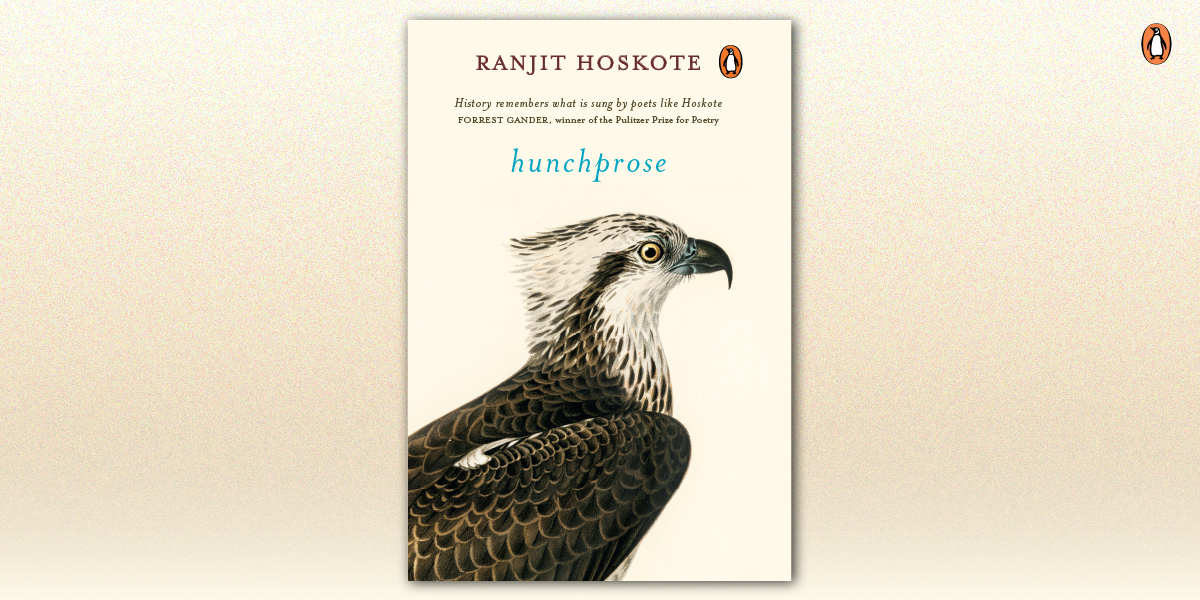
In times of darkness, there has and will always be poetry. Ranjit Hoskote’s Hunchprose is an intimate crafting of vulnerability, beauty, and the feeling of estrangement that accompanies long durations of social anxiety. Here is an excerpt from the eponymous poem, and a few others:
Hunchprose
He calls me Hunchprose but what’s a word
between murderous rivals?
Across from me he strops his fine blade
smooth talker barefaced liar pissfart
teller of tall tales who wraps you up
in his flying carpet serves you snake oil
carries off the princess every time.
And I what can I offer you except
fraying knots coiled riddles scrolled bones
keys to doors that were carted away by raiders
betrayed by splayed light and early snow.
Lost doors I could have opened with my breath.
Call me Hunchpraise. I bend over my inkdrift words.
And when I spring back up I sting.
Sidi Mubarak Bombay (1820–1885)
I should go home now, but I forget where that is.
A child, I was sold for a length of cotton and hammered into a link in a
chain of caravans. Taken across the sea in a dhow. The Arab slavers had
been generous with the whip. The Gujarati merchant who bought me
had a sense of humour. He called me Mubarak, Blessed.
Many years I worked for him in Bombay. City of opium warehouses.
City of cotton godowns. City of spice stores. City of jahazis, munshis,
khalasis, sarafs, bhishtis, sepoys that was the only family I knew. So I
called myself Bombay.
My seth died, leaving instructions that I was to be freed. I went back
to Zanzibar and built a house. In Bombay I was a Sidi, a man from
the Zanj, a man the colour of night. In Zanzibar I spoke Gujarati,
Hindustani, two words of English. Stuttered in Kiswahili. But this
new–old country spoke to me in rhymes of soil, sand, river, jungle. It
brought me gold. Coral. Also pearls.
Speke Sahib, Bwana Speke, wanted me to be his guide. Then Burton
Hunchprose||Ranjit Hoskote
Sahib came. Bwana Burton. Then Bwana Stanley. Bwana Speke was
looking for the source of the Nile. So were they all. I was their compass
and their sextant. With them, I looked for the source of the Nile.
Once, we nearly died. As if the journey was cursed. Burton Sahib
vomiting all the time. Bwana Speke going blind, his eyes gummy and
swollen with too much dreaming. At last, Ujiji. The lake rippled from
one end of the world to the other. Wide as a sea cradled in a giant’s
palm. God forgive us, we tried to cross it. Bwana Speke lost his hearing.
A beetle had crawled into his ear. What afrit possessed him I don’t
know, but he tried to get it out with a knife. No boats large enough to
cross that lake. Later, I crossed Africa from coast to coast. Walked more
than any other man alive. Logged six thousand miles, most of it on foot,
match that if you can. Sometimes donkeys.
Long after I left Bombay and went back to Zanzibar, its smells followed
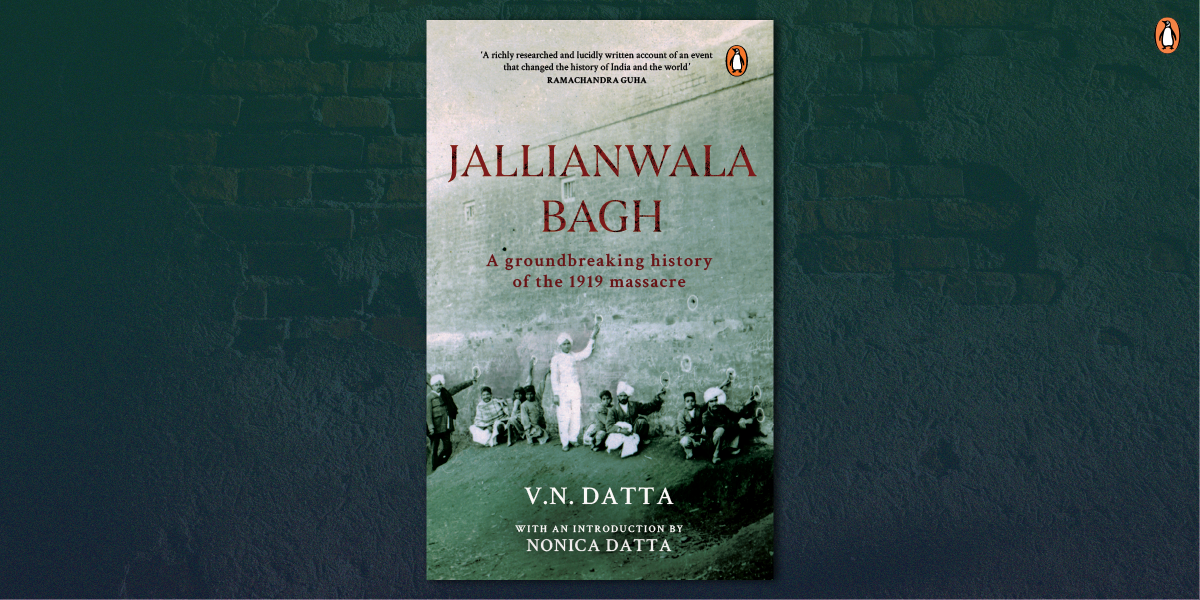
V.N. Datta’s book remains relevant and immediate to this day. While his research documents the events of the Jallianwala Bagh massacre, its history, context and aftermath, it also reveals the failure of larger institutions of power and control. Here is an excerpt from the introduction to the 2021 edition:
In April 2019, 100 years after the massacre, the nation remembered Jallianwala Bagh as a major historical event in the long tale of Indian nationalism and independence. Jallianwala Bagh has become an integral part of the grand saga of the nation’s history. Yet, not all local memories match the prevailing narrative; and here Datta’s book reminds us not to be swayed by the nationalist frenzy.
As preparations were underway for the centenary commemoration, I walked into Jallianwala Bagh intending to unearth its hidden histories. I met a Sikh policeman at the gate who led me to the narrow ‘Historical Lane’ to the Bagh. He told me that Dyer had brought guns and troops through this constricted passage to shoot at the innocent crowd that had assembled in the Bagh on 13 April, the day of the Baisakhi mela, which is celebrated with much fanfare in Punjab. ‘There were no exit points,’ he says. ‘People in panic ran to the walls to escape. They jumped into the khoo [well].’
While in the Bagh, I was taken over by mixed feelings. It looked like an insignificant garden with some old trees abutting the residential buildings at the back. However, there was something eerie about the place. The very ordinariness of the site was almost shocking in view of the violence that occurred there. Of course, there are commemorative structures that are not ordinary. To the right is the amar jyoti, the eternal flame. The pedestal is inscribed with the words Vande Mataram, praise to the motherland. There is also an old samadhi with a dome. At the centre of the Bagh stands an impressive oblong-shaped cenotaph. And to its right is the deadly khoo. Further down is the passage to the Martyrs’ Gallery and a museum. The bullet-ridden wall represents the horror that occurred here. The gaping marks are a tragic testimony to Dyer’s savagery in the Bagh. They are all too visible. The plaque says,
The wall has its own historic significance as it has thirty-six bullet marks which can be easily seen at present and these were fired into the crowd by the order of General Dyer. Moreover, no warning was given to disperse before Dyer opened fire which [sic] was gathered here against the Rowlatt Act. One Thousand Six Hundred and Fifty Rounds were fired.
…The Bagh shapes a national memory and constructs a national past through a patchwork of myth and history, fact and fiction. As Madan Lal Vij, the city’s historian, told me, ‘After the kand [scandalous episode], Jallianwala Bagh became a historic garden and a national memorial.’ The city’s local tragedy is fashioned as a national crisis through the idea of shahadat, martyrdom. A white flame-like sculpture stands with faces of martyrs and all their names engraved below. The compound surrounding Jallianwala Bagh is today part of a larger heritage area that includes the Golden Temple and the old Town Hall. The Congress narrative, as shown on the plaque, forges a direct connection between the massacre and the Rowlatt Act.
Jallianwala Bagh||V.N. Datta
The construction of a definitive history in Jallianwala Bagh obfuscates the complex truths of the massacre, which contain unresolved contradictions and ambiguities. One such ambiguity is the nationalist attempt to establish an unmediated relationship between the crowd in the Bagh and the anti-Rowlatt Act protests. However, the irony is that to present the crowd as agitators alone would authenticate the claims of Dyer and official histories and do an injustice to the plural memories and differentiated experiences of the victims. I asked the locals to share their memories. ‘It was a random crowd, some were playing cards, others had come to celebrate the Baisakhi mela,’ says the octogenarian Om Prakash Seth from Katra Ahluwalia. ‘It was not a political meeting,’ adds Trilok Chand, one of the oldest booksellers at Hall Bazaar. Udham Singh’s history in the Bagh presents yet another dilemma. It is doubtful whether he was ever present in the Bagh at the time of the massacre. Doubtless, Jallianwala Bagh is primarily dominated by the story of Gandhi’s satyagraha and Udham Singh’s martyrdom.
The tailored history of the Bagh tends to ignore the diverse echoes and voices. We know little about the people who were in the Bagh and what they were up to. Popular memories too are shifting. Dyer’s shooting is no longer central to their recollections. People feel excluded from the mainstream history of Jallianwala Bagh. The locals see themselves as victims of a state that has let them down consistently since 1919.
…My journey to Amritsar tracing the memories of Jallianwala Bagh was greatly enriched by Datta’s insights and revelations. Even after the 100th year of commemoration, his work becomes all the more immediate. As a historian writing in the 1960s, his crafting of an intricate narrative and analysis of 1919, uncomfortably entangled with local and national histories, is no mean feat. Recognized as a classic across the global community of scholars, V.N. Datta’s Jallianwala Bagh deserves a wider readership for generations to come.
Some books never cease to remain relevant. Jallianwala Bagh is one such.
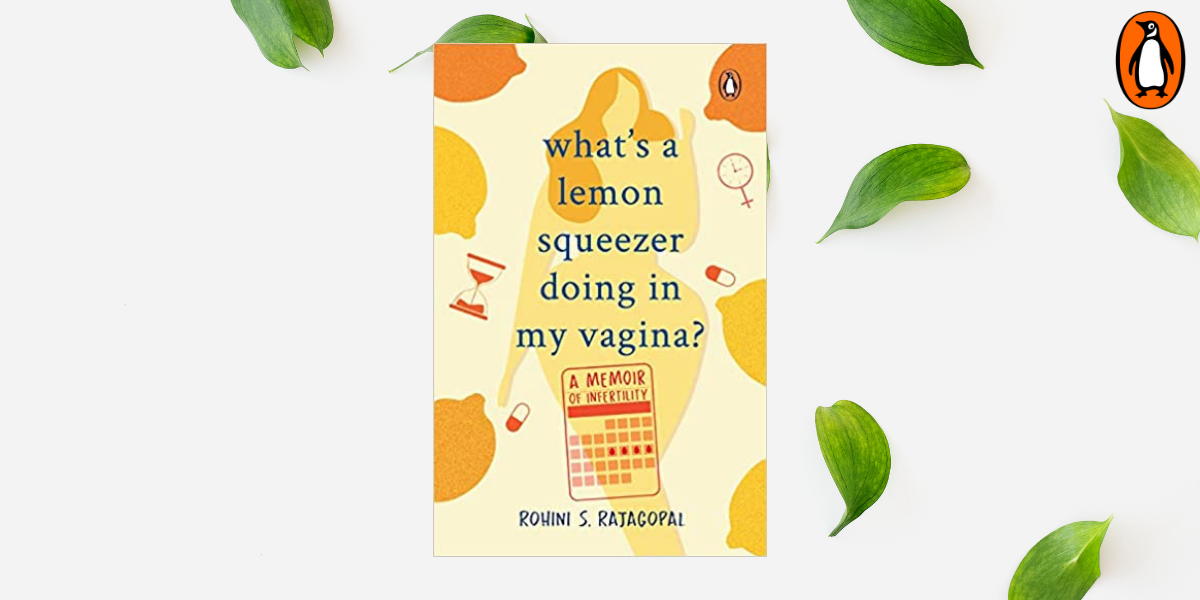
When Rohini married Ranjith and moved to the ‘big city’, they had already planned the next five years of their life: job, home, and then child. After three years of marriage and amidst increasing pressure from family, they decided to seek medical help to conceive. But they weren’t prepared for what came next-not only in terms of the invasive, gruelling and deeply uncomfortable nature of infertility treatment but also the financial and emotional strain it would put on their marriage, and the gnawing shame and feeling of inadequacy that she would experience as a woman unable to bear a child.
What’s a Lemon Squeezer Doing in My Vagina? is a witty, moving and intensely personal retelling of Rohini’s five-year-long battle with infertility, capturing the indignities of medical procedures, the sting of prying questions from friends and strangers, the disproportionate burden of treatment on the woman, the everyday anxieties about wayward hormones, follicles and embryos and the overarching anxiety about the outcome of the treatment. It offers a no-holds-barred view of her circuitous and highly bumpy road to motherhood.It was 8 a.m. on a Saturday and the reception area was already packed with couples at various stages of treatment. As first-time visitors, we paid the registration fee and went into a consultation room. A bespectacled, presumably junior consultant motioned us to sit down and began inquiring into our condition, reading out queries from a four-page data sheet in her hand and filling it in as the Q&A progressed.
There were questions on our medical history, the nature of my menstrual cycle, our lifestyle, hereditary diseases and, of course, the most critical query: how long we had been trying to conceive. That probably did not tick all the boxes, so what followed was a point-by-point probing of our sex life.
‘How often do you have intercourse?’
‘Once or twice a week.’
‘When was the last time you had intercourse?’
‘Last Sunday.’
‘Have you experienced any sexual dysfunction?’
‘No.’
‘Do you have any history of sexually transmitted diseases?’
‘No.’
Our tone was flat and deadpan, betraying none of the unease we felt, as if it were routine to discuss the schedule and specifications of our sex life. Of course, only I spoke.
Ranjith leaned back in his chair, arms folded across his chest, and uttered a syllable or two when a question was specifically directed at him. He had come there only for me.
Once the patient history form was filled up the doctor said she would have to examine me and pointed to a bed in the same room. I knew what was coming and didn’t look forward to it, but agreed obediently. Removing my shoes, I stepped on a two-rung stool and climbed onto the steel examination table while she drew a curtain around it.
‘Please remove your pyjamas,’ she ordered.
I loosened the knot of my salwar, pulled it down along with my underwear and lay down on my back. She wore her gloves, dipped her index and middle fingers in jelly and inserted them inside my vagina, feeling the contours of my insides in rough, rapid moves. I held my breath, interlocked my fingers tightly and focused unblinkingly on the ceiling.
What’s Lemon Squeezer Doing In My Vagina | Rohini S. Rajagopal
After a few seconds she noted, ‘There is nothing anatomically wrong with your body.’
‘Hmm,’ I exhaled. The only thing I cared for was the departure of the groping fingers and restoration
of dignity to my half-naked self.
Back at the table, she handed us a printout that laid down the next steps. ‘Please come back once you finish all the tests on this sheet,’ she said. We nodded dutifully and stepped out of the room, our to-do list in hand. We chose the diagnostics lab first. There were twenty odd tests to strike off the list—from HIV to blood sugar to the various hormones that govern reproduction. The phlebotomist1 indicated a student chair and asked me to place my extended arm on the foldable writing pad. He drained several millilitres of my blood into colour-coded vials. I did not fear needles and breathed easily through the prick of skin and tightness of strap. It was certainly easier than offering access to the inner recesses of my vagina.
Once I was done, Ranjith sat on the same chair and went through the same motions. Next was sperm collection. A male technician handed Ranjith a small plastic container with a white label on it. He asked him to make use of a room at the opposite end of the corridor with the sign ‘Sample Collection’ outside. Ranjith hid the cup in his closed fist and walked into the room. As the door closed I caught a fleeting glimpse of its interiors—peeling walls and a broken chair. I sat on the bench, facing the closed door, trying to block all thoughts. After fifteen minutes he emerged.
The final stop was ultrasound. I was led into a room overpowered by medical equipment and asked to lie down on a long, narrow bed. My salwar and underwear rested on hooks in the bathroom. A chirpy radiologist photographed the insides of my uterus with the transducer, noting down measurements of my ovaries on paper. Once or twice she yelped in delight at the images that appeared on the screen.
‘Excellent. A triple lining!’ she said. I maintained my breathless silence, again fixated only on when the ultrasound probe would be withdrawn from my vagina.
As soon as Ranjith and I stepped into the clinic, it was as if an invisible wall had emerged to separate us—husband and wife—snapping the lines and wires of marital communication. We walked around the clinic like zombies, taking instructions, undoing zippers, lowering underwear, offering arms for needles . . . It was like a spontaneous, self-imposed blockade. We resisted processing the happenings around us. We resisted conversation. We resisted each other’s eyes even, each feeling sickeningly guilty that the other had been dragged into such a distasteful setting.
We had come in expecting the privacy and safety of a cosy consultation room, but the fertility clinic turned out to be an open parade in which our self-respect and dignity were systematically poked, squeezed and drained out. It was only about one and a half hours later, when the stripping and skinning were complete, that we were ushered into the cabin of the doctor we had come to meet in the first place.
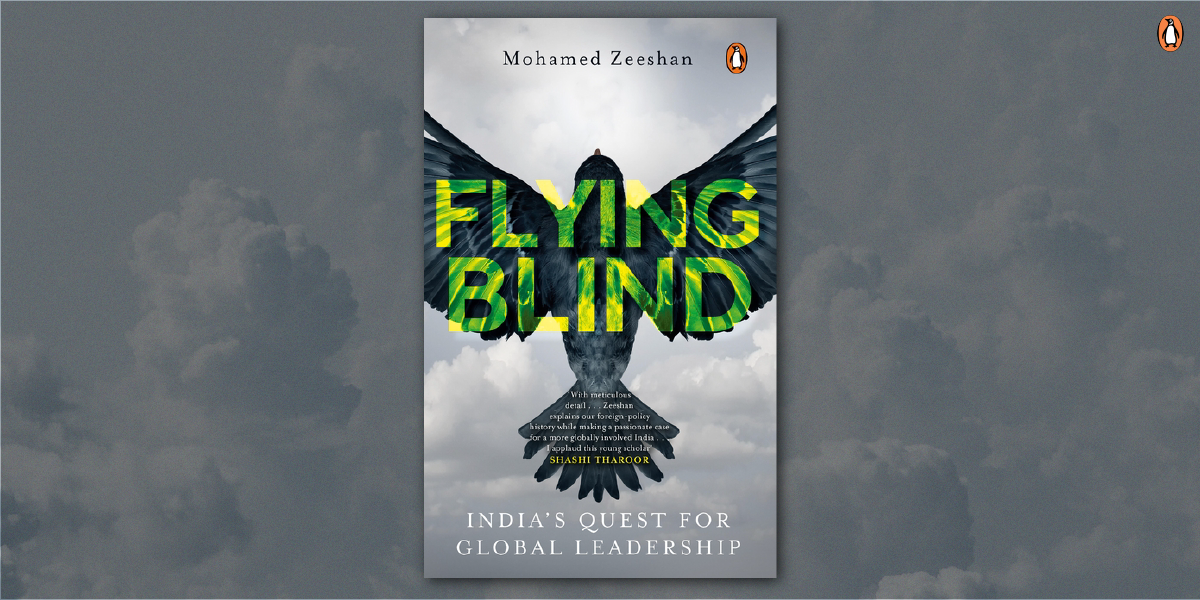
Is India in a position to focus on its foreign policy, or does it have more pressing domestic matters at hand? In this excerpt from his book Flying Blind, Mohamed Zeeshan takes a look at the relationship between India and South Asia.
~
Welcome to the world’s most fearsome neighbourhood. It hosts two nuclear-armed residents, has seen civil wars in at least three countries, and houses the world’s oldest, earliest and longest- running United Nations military observer mission. There is a third nuclear power just outside the door, and one of those civil wars ran for as long as three decades. All this is while discounting other nearby countries (hint: Afghanistan) which have been ravaged by multilateral fighting and terrorism for decades.
South Asian countries rarely contain problems within their own borders. Over the years, the region has witnessed cross-border military action on numerous occasions on multiple fronts—from Afghanistan in the north-west to Sri Lanka in the south-east. Domestic troubles often have region-wide implications—and civil wars in one country have killed prime ministers in another. Domestic political interests in provinces of India have often compromised deals and agreements with neighbours. In 2011, India and Bangladesh tried to sign a water-sharing agreement, in a bid to put an end to the long-running dispute over the Teesta River that flows across the two countries. The deal was quickly thwarted by opposition from the state of West Bengal.
Flying Blind||Mohamed Zeeshan
Such difficulties have led South Asia to become the least integrated region in the world. In his 1914 poem titled ‘Mending Wall’, Robert Frost wrote, ‘Good fences make good neighbours.’ South Asia took him seriously. South Asia is one of the world’s fastest-growing regional economies, but that is not because of ties among its members: Trade between South Asian countries is a negligible 5 per cent of the total trade conducted by all South Asian countries (it was 3 per cent in 1990)—and represents just 2 per cent of South Asian GDP. Compare all this with the Association of South East Asian Nations (ASEAN) in South East Asia: Trade within that region is a healthy 25 per cent of all trade by ASEAN countries—and represents more than 20 per cent of ASEAN GDP. With nearly all intra-ASEAN tariffs eliminated, trade grew from $68.7 billion in 1995 to $257 billion in 2017, according to the Asian Development Bank.
But this sort of heavy fencing makes South Asia a problem for India; indeed, it is so critical a problem that New Delhi’s plans for global leadership will fall flat if India does not win support in South Asia. Consider this the veto vote over Indian leadership. No global power ever rises if it is constantly putting out fires in its neighbourhood. And the bad news is that it is much easier for India to take action and gain influence as far as Nicaragua or New Zealand than it is to win over its neighbours.
In recent years, South Asia has increasingly become a distraction for India while it seeks to spread its reach further afield in the world. For little gain to anybody in the region, New Delhi’s resources of strategic thinking have been drained disproportionately by intractable challenges in the neighbourhood. With every country, there is a headline dispute to which everything else is often held hostage: In Sri Lanka, it is the rights of the Tamil minority and Indian Tamil fishermen; in Nepal, it is the rights of the Madhesi tribes which populate the Terai plains; in Bangladesh and Pakistan, it is the partitions and their many associated headaches. In all countries, there is of course the big white elephant: Chinese interference to counter-balance Indian hegemony.
Indian diplomats are often frustrated that South Asia is not well-integrated. All large neighbours are always treated as threats by default anywhere in the world. But economic interests often help boost at least economic integration. This is what China has managed to do in East Asia and South East Asia, despite long- running animosity in those regions towards Beijing and even explosive ongoing disputes. The Philippines, for instance, welcomes in Chinese investment on its railroads and highways, even as it locks horns with Beijing in an international tribunal over the South China Sea. Yet, in South Asia, even economic ties are scorned at suspiciously.
~
Flying Blind is an essential read for anyone hoping to understand the multi-layered complexities of India, its relationship with the subcontinent, and its foreign policy.
Twenty years later, three people are looking for you.
One is dying to meet you again.
The other wishes you had never met them.
The third wishes they could have met you at least once.
You are one person. Aren’t you? But you are not the same person to each of them.
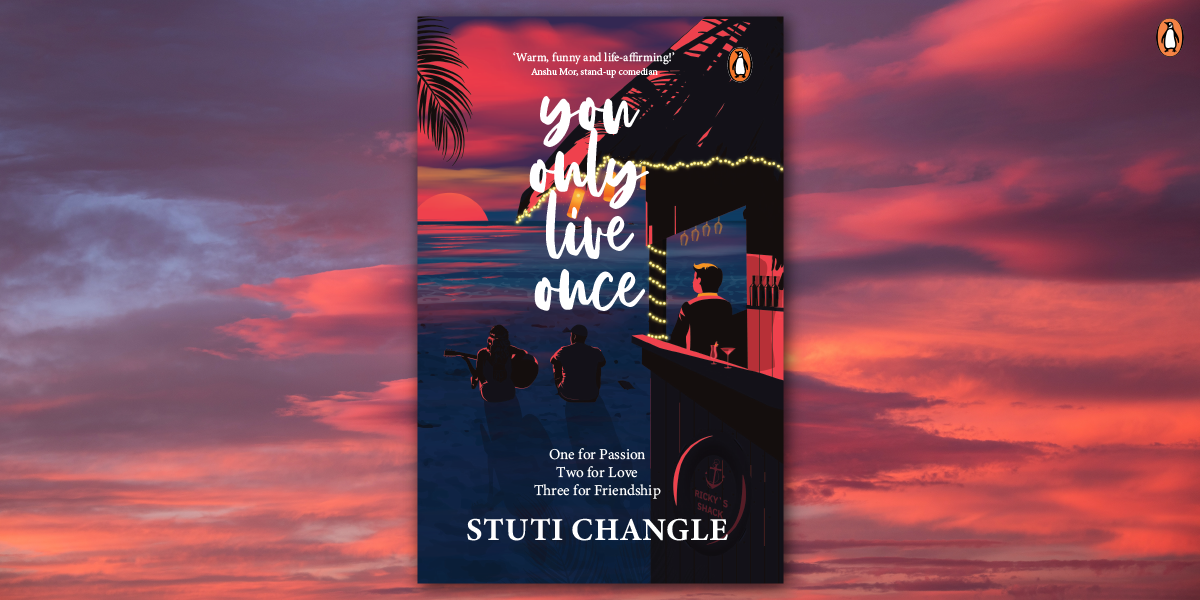
In You Only Live Once, find the answers about your own life in this story about searching for love and discovering yourself. Join a broken but rising YouTube star Alara, a struggling but hopeful stand-up comedian Aarav, and a zany but zen beach shack owner Ricky as they undertake a journey to find the truth behind the disappearance of Elisha.
Here’s an excerpt from the book that throws light on the quandaries in Alara’s heart and her longing for love.
**
Irena, my stepmother, is a new-age fashion influencer and helped me set up my YouTube channel. She isn’t really talented, but she married a wealthy guy, and fancy social media accounts are part of the assets you create if you have a lot of money. After all, rich people can afford to buy new clothes for every post they make.
Having said that, she is a nice person at heart. I don’t really hold anything against her.
I’m not close to anyone at home. Not really. I’m close to my guitar. It’s because it always meets my expectations. People? They often fail to do so. Unfulfilled expectations lead to unfulfilled relationships.
‘Hey! Alara,’ says my step-aunt Betty as I enter La Epicurean.
‘You’ve grown up to be a beautiful woman,’ she continues.
‘Thank you,’ I respond. I don’t talk a lot when it comes to Irena’s siblings. They’re five women, full of gossip and unnecessary banter. Also, here in Czech, women outnumber men, so they’re on a constant lookout for a foreigner to settle down with. Betty is the youngest one and I heard her own siblings discuss her relationship with a guy from New York who is half her age. He is the one who gave her the name Betty too. Living the American Dream has fascinated the world since the 1960s.
‘Which song are you performing tonight?’ she asks.
‘Time,’ I say, wondering if she would even understand the depth of the concept. Time it is, the one thing that has never been on my side. Time is what ruined my game early on. Time is what I challenge as I hope to find my mom, or perhaps, an answer.
‘You have not published a new song in months. What keeps you busy these days?’ she inquires. ‘You don’t even have a day job,’ she adds.
You Only Live Once || Stuti Changle
Yes, this is where I draw the line. Relatives can get so unbearable at times. I am facing a writer’s block, I write my own songs after all. What would she know of it? She is the kind who would seek Irena’s help to write even an email.
‘Soon,’ I smile wide. Curt. Short. Sweet. She deserves to know that much.
It’s been quite some time since I last published a song on YouTube. I wish to release my first album. But I have run out of ideas, literally. I know deep within my heart that leaving this place would help me ideate and write songs. Here, I am consumed with much more than writing and performing at cafes. I have to attend customary functions like today. My dad is respected in the community, and that’s the thing about rich people. They never get bored of partying and socializing. Me? I told you, right? I struggle with a sense of belonging.
I long to be myself sans all the responsibilities and sensibilities I find myself compelled to fit into. I long to meet you, mom. Let me tell you, your mother would perhaps be the most overlooked person by you, trust me. You might not even appreciate the food that she cooks with all the love. But there are people like me who don’t even know what food cooked with love tastes like.
Angie Thomas’ new book Concrete Rose returns to the site of her previous work, The Hate u Give, where the narrative events are catalysed by the police shooting of an unarmed black teenager. We’re returning to Thomas’ books, which are inspiring and necessary, delving into conversations around race, friendship, activism, and giving us characters that are unforgettable. Here is an excerpt from The Hate u Give:
A commotion stirs in the middle of the dance floor.
Voices argue louder than the music. Cuss words fly left and right.
The Hate U Give||Angie Thomas
My first thought? Kenya walked up on Denasia like she promised. But the voices are deeper than theirs.
Pop! A shot rings out. I duck.
Pop! A second shot. The crowd stampedes toward the door, which leads to more cussing and fighting since it’s impossible for everybody to get out at once.
Khalil grabs my hand. “C’mon.”
There are way too many people and way too much curly hair for me to catch a glimpse of Kenya. “But Kenya—”
“Forget her, let’s go!”
He pulls me through the crowd, shoving people out our way and stepping on shoes. That alone could get us some bullets. I look for Kenya among the panicked faces, but still no sign of her. I don’t try to see who got shot or who did it. You can’t snitch if you don’t know anything.
Cars speed away outside, and people run into the night in any direction where shots aren’t firing off. Khalil leads me to a Chevy Impala parked under a dim streetlight. He pushes me in through the driver’s side, and I climb into the passenger seat. We screech off, leaving chaos in the rearview mirror.
“Always some shit,” he mumbles. “Can’t have a party without somebody getting shot.”
He sounds like my parents. That’s exactly why they don’t let me “go nowhere,” as Kenya puts it. At least not around Garden Heights.
Concrete Rose is a return to Garden Heights, seventeen years before the events depicted in The Hate U Give. It is a fierce and inspiring account of what it means to grow up as a black man in the United States. Here is an excerpt:
“That trifling heffa! And I don’t mean Iesha,” Ma says. “I mean her momma!”
Ma ain’t stopped fussing since we left the clinic.
At first I thought Iesha and Ms. Robinson stepped outside. Nah, they left. One of the nurses said she pointed out they were leaving the car seat. Ms. Robinson told her, “We don’t need it anymore,” and shoved Iesha out the door.
We went straight to their house. I banged on the doors, looked through the windows. Nobody answered. We had no choice but to bring li’l man home with us.
Concrete Rose||Angie Thomas
I climb our porch steps, carrying him in his car seat. He so caught up in the toys dangling from the handle that he don’t know his momma left him like he nothing.
Ma shove the front door open. “I had a funny feeling when I saw all them clothes in that diaper bag. They shipped him off without a word!”
I set the car seat on the coffee table. What the hell just hap- pened? For real, man. I suddenly got a whole human being in my care when I never even took care of a dog.
“What we do now, Ma?”
“We obviously have to keep him until we find out what Iesha and her momma are up to. This might be for the weekend, but as trifling as they are…” She close her eyes and hold her forehead. “Lord, I hope this girl hasn’t abandoned this baby.”
My heart drop to my kicks. “Abandoned him? What I’m supposed to–”
“You’re gonna do whatever you have to do, Maverick,” she says. “That’s what being a parent means. Your child is now your responsibility. You’ll be changing his diapers. You’ll be feeding him. You’ll be dealing with him in the middle of the night. You—”
Had my whole life turned upside down, and she don’t care.
That’s Ma for you. Granny say she came in the world ready for whatever. When things fall apart, she quick to grab the pieces and make something new outta them.
“Are you listening to me?” she asks.
I scratch my cornrows. “I hear you.”
“I said are you listening? There’s a difference.”
“I’m listening, Ma.”
“Good. They left enough diapers and formula to last the
weekend. I’ll call your aunt ’Nita, see if they have Andre- anna’s old crib. We can set it up in your room.”
“My room? He gon’ keep me awake!”
She set her hand on her hip. “Who else he’s supposed to keep awake?”
“Man,” I groan.
“Don’t ‘man’ me! You’re a father now. It’s not about you anymore.” Ma pick up the baby bag. “I’ll fix him a bottle. Can you keep an eye on him, or is that a problem?”
“I’ll watch him,” I mumble.
“Thank you.” She go to the kitchen. “‘He gon’ keep me awake.’ The nerve!”
I plop down on the couch. Li’l Man stare at me from the car seat. That’s what I’m gon’ call him for now, Li’l Man. King Jr. don’t feel right when he my son.
My son. Wild to think that one li’l condom breaking turned me into somebody’s father. I sigh. “Guess it’s you and me now, huh?”
I hold my hand toward him, and he grip my finger. He small to be so strong. “Gah-lee,” I laugh. “You gon’ break my finger.”
He try to put it in his mouth, but I don’t let him. My fingernails dirty as hell. That only make him whine.
“Ay, ay, chill.” I unstrap him and lift him out. He way heavier than he look. I try to rest him in my arms and sup- port his neck like Ma told me to. He whimper and squirm till suddenly he wailing. “Ma!”
She come back with the bottle. “What, Maverick?”
“I can’t hold him right.”
She adjust him in my arms. “You relax, and he’ll relax.
Now here, give him the bottle.” She hand it to me, and I put it in his mouth. “Lower it a little bit, Maverick. You don’t wanna feed him fast. There you go. When he’s halfway through it, burp him. Burp him again when he’s done.”
“How?”
“Hold him against your shoulder and pat his back.”
Hold him right, lower the bottle, burp him. “Ma, I can’t—” “Yes, you can. In fact, you’re doing it now.”
~
Two beautiful, urgent reads that will stay with you.