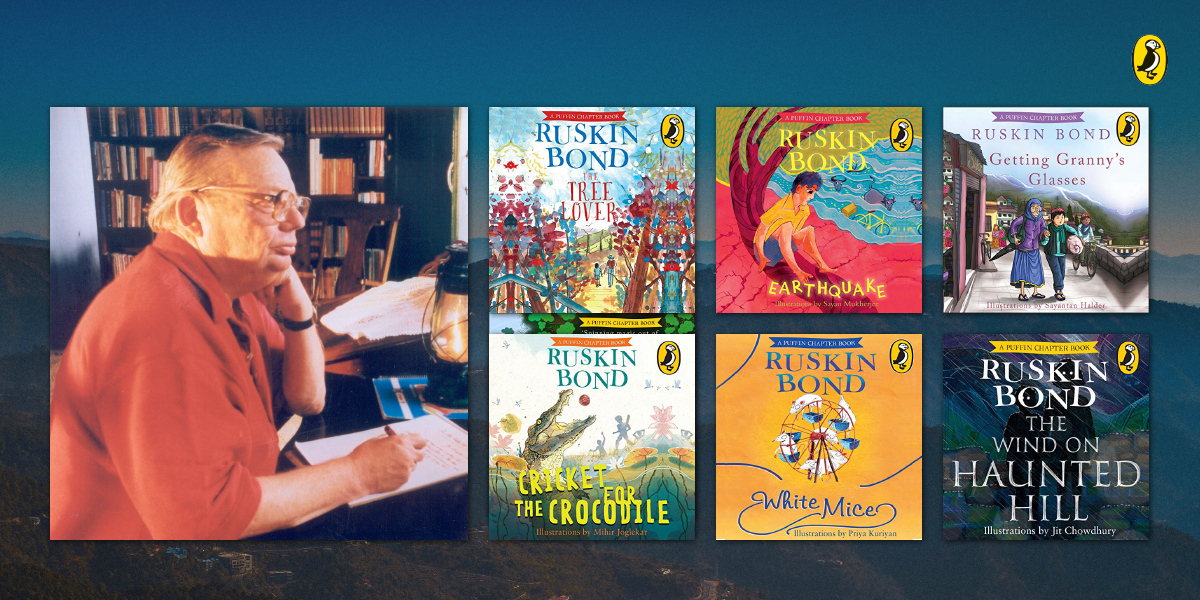
In a world that seems increasingly complicated, we all need a quick step through the looking-glass into the quietly beautiful world of Ruskin Bond, a hillside utopia where generous old ladies provide solace to thoughtful children (and to our souls), and the clouds roll gently over fruit-laden trees. Ruskin Bond is truly among the most avuncular figures of literary India, bringing the magic of wistful nostalgia and bursts of quiet happiness into our imaginative landscapes for nearly half a century. On his 88th birthday, we bring to you some auditory therapy, a soothing balm for overtired brains, Ruskin Bond’s poignant prose rendered even more magical by the gentle calm of his own voice!
Read on for a list of some of his most loved works narrated as audiobooks by our favourite author himself!
Cricket for the Crocodile
Ranji’s team finds an unexpected opponent – a nosy crocodile – when they play a cricket match against the village boys. Annoyed at the swarms of boys crowding the riverbank and the alarming cricket balls plopping around his place of rest, Nakoo the crocodile decides to take his revenge.
The Wind On Haunted Hill
‘Who…whoo…whooo cried the wind as it swept down from the Himalayan snows.’
The wild wind pushes open windows, chokes chimneys, and blows away clothes as it huffs and puffs over the village by Haunted Hill, where Usha, Suresh, and Binya live. It’s even more mighty the day Usha is on her way back from the bazaar. A deep rumble echoes down the slope and a sudden flash of lightning lights up the valley as fat drops come raining down.
In search of shelter, Usha rushes into the ruins on Haunted Hill, grim and creepy against the dark sky. Inside, the tin roof groans, strange shadows are thrown against the walls, and little Usha shivers with fear.
For she isn’t alone.
A gritty, hair-raising story about friendship, courage, and survival, this stunning edition will introduce another lot of young listeners to the magic of Ruskin Bond’s craft.
The Cherry Tree
Rakesh plants a cherry seedling in his garden and watches it grow. As seasons go by, the small tree survives heavy monsoon showers, a hungry goat that eats most of the leaves, and a grass cutter who splits it into two with one sweep. At last, on his ninth birthday, Rakesh is rewarded with a miraculous sight – the first pink blossoms of his precious cherry tree!
White Mice
A tale of sweet revenge!
Ruskin is keen to teach his scatterbrained uncle a lesson. After all, he put him on the wrong train! Armed with gifts from his new friend, the stationmaster – yummy rasgullas and a pair of beautiful white mice – Ruskin devises the perfect payback.
Peppered with endearing characters, this is one of Bond’s most unforgettable tales.
Getting Granny’s Glasses
Mani’s Granny is 70 and can barely see through her old, scratched glasses. With only 150 rupees in their pockets and a thirst for adventure, Mani and Granny set off to buy a new pair. On the way, they get drenched in the rain, run into mules, and encounter a terrible landslide. Will Granny ever be able to reach the town and get herself a new pair of glasses?
The Tree Lover
Everything that you’ve always loved about Ruskin Bond is back.
His mesmerizing descriptions of nature and his wonderful way with words – this is Ruskin Bond at his finest.
Listen in as Rusty tells the story of his grandfather’s relationship with the trees around him, who’s convinced that they love him back with as much tenderness as he loves them.
Earthquake
‘What do you do when there’s an earthquake?’ asks Rakesh. Everyone in the Burman household has their own ideas, but when the tremors begin and things start to quake and crumble, they are all taken by surprise. Amidst the destruction, Rakesh’s family stays strong. But will they survive the onslaught of yet another earthquake?
Gather your family (or just your own thoughts) for an incredibly relaxing audio interlude after downloading your audiobooks!
‘May’ is a word filled with promises and possibilities. It is also a word that conveys blessings and best wishes. These are emotions the entire human race has been expressing and feeling toward one another constantly through this difficult period that has spanned over a year. A homograph to this word that is so laden with potential and compassion, is the month we have now stepped into. May ‘may’ have a lot to offer you in terms of comfort and relief, but what we certainly have to offer you this month is an array of our latest releases. May they bring a little light, love, laughter, knowledge and hope into your lives.
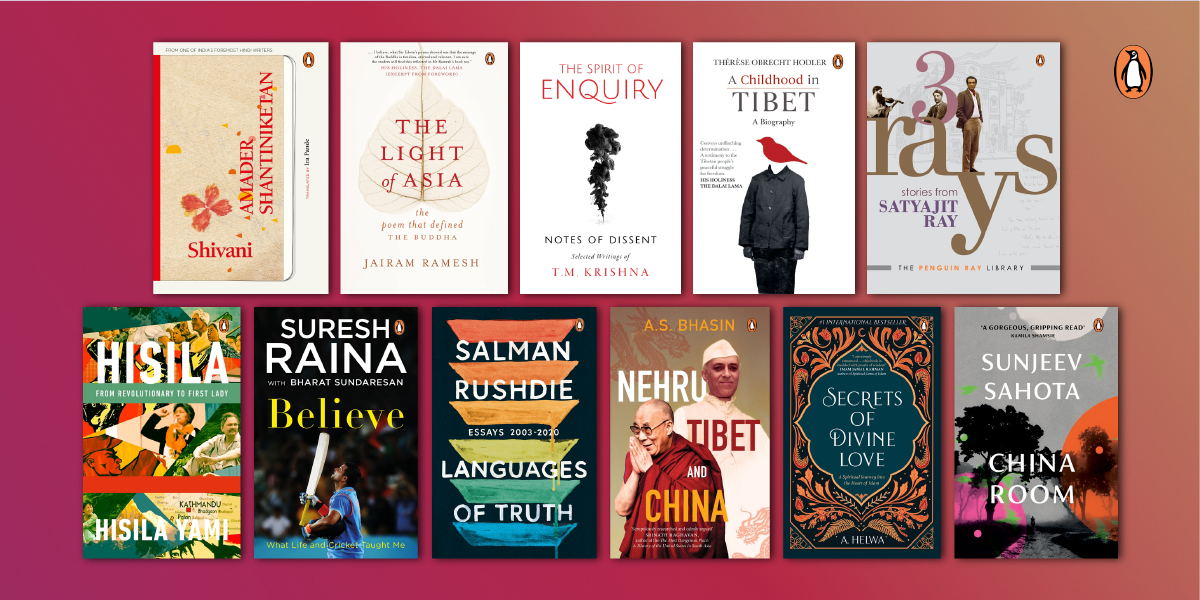
Hisila||Hisila Yami
Hisila
In this fascinating book, Hisila Yami traces her journey from being a young Nepali student of architecture in Delhi in the early eighties to becoming a Maoist revolutionary engaging in guerrilla warfare in Nepal. Yami was one of two women leaders who were a part of the politburo of the Communist Party of Nepal, which led the revolutionary People’s War.
This lucidly written political memoir may talk about gaining political awareness, joining protests, being imprisoned, participating in the People’s War, and later her experiences as the first lady and a minister. But, at the same time, it’s also a narrative that offers glimpses of her personal life. She candidly writes about falling in love and marrying a fellow politician, Baburam Bhattarai, who went on to become the prime minister of Nepal. From how she balanced her political life with motherhood to what it meant to be a woman in the communist party that launched a civil war, Yami narrates an unforgettable account of a remarkable life.
Three Rays||Satyajit Ray
Three Rays
Satyajit Ray (1921-1992), through his life, philosophy and works offered a unique aesthetic sensibility, which took our cinema, art and literature to a new height. Ray, an ace designer, music composer, illustrator and a gifted writer, gave us the iconic Feluda and Professor Shonku, loved and revered by millions of readers.
Celebrating his centenary birth anniversary, Three Rays: Stories from Satyajit Ray, the first book in ‘The Penguin Ray Library’ series, opens a window to his brilliance. With more than forty previously unpublished stories, autobiographical writings and illustrations by Ray, this volume opens a window to the Master’s creative genius.
Secrets of Devine Love||A.Helwa
Secrets of Divine Love
Secrets of Divine Love draws upon the spiritual secrets of the Qu’ran, mystical poetry and stories from the world’s greatest prophets and spiritual masters to help you reignite your faith, overcome your doubts and deepen your connection with God. Practical exercises and guided meditations will help you develop the tools and awareness to overcome the inner critic that prevents you from experiencing God’s all-encompassing love.
Through the principles and practices of Islam, you will learn how to unlock your spiritual potential and your divine purpose. This insightful book uses a rational yet heart-based approach towards the Qu’ran that enlightens and inspires towards a deeper intimacy with God.
Believe||Suresh Raina, Bharat Sundaresan
Believe
Believe, Sachin Tendulkar told him – and he took it to heart, getting the word etched on his arm as a tattoo.
In this book, Suresh Raina takes us through the challenges he faced as a young cricketer. He was bullied as a child, but he overcame every adversity life threw at him and never gave up. This is the story of the lessons he learnt and the friendships he built.
Peppered with invaluable insights – about the game and about life – that Raina acquired from senior colleagues, this book will make you believe in the power of hard work, love, luck, hope and camaraderie. It is a journey through the highs and lows in the career of a man who saw his world fall apart and yet became one of the most influential white-ball cricketers India has ever seen.
Languages of Truth||Salman Rushdie
Languages of Truth
Salman Rushdie is celebrated as a storyteller of the highest order, illuminating truths about our society and culture through his gorgeous prose. In his latest collection of nonfiction, he brings together insightful essays and speeches that focus on his relationship with the written word and reinforce him as one of the most original thinkers of our time.
Gathering pieces written from 2003 to 2020, Languages of Truth chronicles Rushdie’s intellectual engagement with a period of momentous cultural shifts. He delves into the nature of storytelling as a human need in what emerges as a love letter to literature. Rushdie explores what the work of authors from Shakespeare and Cervantes to Samuel Beckett, Eudora Welty, and Toni Morrison mean to him. He delves deep into the nature of ‘truth’, revels in the vibrant malleability of language, the creative lines that join art and life, and looks anew at migration, multiculturalism and censorship.
Enlivened by Rushdie’s signature wit,Languages of Truth offers his piercingly analytical views on the evolution of literature and culture as he takes us on a tour of his own exuberant imagination.
Nehru, Tibet and China||Avtar Singh Bhasin
Nehru, Tibet and China
On 1 October 1949, the People’s Republic of China came into being. Power moved from the hands of the nationalist Kuomintang government to the Communist Party of China headed by Mao Tse Tung. All of a sudden, it was not only a new China that India had to deal with but also a Tibet which was under increasing pressure.
Clearly, newly independent India, with Prime Minister Jawaharlal Nehru at its helm, was navigating choppy waters. Its relations with China deteriorated, eventually leading to the Indo-China war in 1962. Today, more than six decades after the war, we are still face border disputes with China that seem to routinely grab headlines. It leads one to question what exactly went on during the emergence of a new China and why have we repeatedly failed to arrive at a solution?
Based on meticulous archival research, this book analyses the events from 1949 to the Indo-China war in 1962 and its aftermath to uncover answers to these burning questions.
A Childhood in Tibet||Thérèse Obrecht Hodler
A Childhood in Tibet
Tendöl Namling turned 60 in 2019. She was born at the time the Dalai Lama fled from Lhasa and the uprising of his people by the Chinese People’s Army was brutally suppressed. She lived 22 years under Chinese rule. As daughter of a high government official, she underwent the ordeal of ‘re-education’ with full force. All she had from these years are painful memories and crumpled photographs of her with friends and cousins in Lhasa, smiling as if nothing happened. When Tendöl turned 10 her brother was arrested and her mother sentenced to ten years in prison. Tendöl was sent to work in road construction for several years, following which she was allowed to start an apprenticeship as motor mechanic. Thanks to the efforts of her family in exile, Tendöl was able to leave Tibet in 1982. After twenty years of hardship she landed in prosperous Switzerland. She struggled to start her life all over again, but never gave up.
In Tendöl’s words, ‘this little book is dedicated to all the Tibetans who continue to rebel against the Chinese occupation’.
The Light of Asia||Jairam Ramesh
The Light of Asia
‘The Light of Asia’is an epic poem by Sir Edwin Arnold that was first published in 1879. It quickly became a huge sensation and has continued to resonate powerfully across the world over the last century and a half. Weaving together literary, cultural, political and social history, Jairam Ramesh uncovers and narrates the fascinating story of this deeply consequential and compelling poem that has shaped our thinking of an ancient sage and his teachings. He brings into this unusual narrative the life of the multi-faceted poet himself who, among other things, was steeped in Sanskrit literature.
Sir Edwin Arnold’s English rendering of the Bhagavad Gita was one of Mahatma Gandhi’s favourites. He was also in many ways the man who may have shaped Bodh Gaya as we know it today.
China Room||Sunjeev Sahota
China Room
A multigenerational novel of love, oppression, trauma and the pursuit of freedom, inspired in part by the author’s own family history, China Room twines together the stories of a woman and a man separated by more than half a century but united by blood.
Mehar, a young bride in the rural Punjab of 1929, is trying to discover the identity of her new husband. She and her sisters-in-law, married to three brothers in a single ceremony, spend their days working in the family’s ‘china room’, separated from the men. When Mehar develops a theory as to which of them is hers, a passion is ignited that puts more than one life at risk.
Spiralling around Mehar’s story is that of a young man who, in 1999, travels from England to a deserted farm, its ‘china room’ locked and barred. In enforced flight from the traumas of his adolescence-his experiences of addiction, racism and estrangement from the culture of his birth-he spends a summer in painful contemplation and recovery, before finally finding the strength to return home.
Amader Shantiniketan||Shivani, Ira Pande
Amader Shantiniketan
Padma Shri and late Hindi author Shivani’s memoirs of studying at the experimental school set up by Rabindranath Tagore, the Ashram, this charming memoir is a loving homage to a grand institution and its legendary gurus. Written from the perspective of a child, it retains the freshness and innocence of an age when experimental education was not merely a trendy movement. Shivani’s vivid pictures of the Ashram and portraits of her teachers and fellow students remain as alive as they seemed when she first wrote this memoir nearly fifty years ago.
Along with the moving tributes she wrote when some of her beloved contemporaries passed away, this slim memoir is a sort of diptych that captures the spirit of the Ashram and the liveliness of its inmates, many of whom went on to become iconic. Shivani’s recall of her time there takes the reader into an enchanted garden that remains as inspirational to her as it was when she went there a lifetime ago.
The Spirit of Enquiry||T.M. Krishna
The Spirit of Enquiry
As a vocalist in the Karnatik tradition, T.M. Krishna eludes standard analyses. Uncommon in his rendition of music and his interpretation of it, Krishna is at once strong and subtle, manifestly traditional and stunningly innovative. His work is spread across the whole spectrum of music and culture, politics and the social sphere; he is at once philosophical, aesthetic and sociopolitical. He asks important questions about how art is made, performed and disseminated. Unabashedly given to rethinking classical paradigms, he addresses crucial issues of caste, class and gender with nuance and openness.
T.M. Krishna’s key writings have been put together for the first time in this extraordinary collection. The Spirit of Enquiry: Dissent as an Art Form draws from his rich body of work, thematically divided into five key sections: art and artistes; the nation state; the theatre of secularism; savage inequalities; and in memoriam. This collection reflects the critical and cultural engagement of one of our finest thinkers, public intellectuals and practitioners of art.
We know that our current times are not the most optimistic. But now more than ever, we believe that books can act as a source of hope and joy, howsoever small, and keep us going.
We have an assorted selection of books for you this May! These will keep your young ones occupied as they spend the summers indoors, inside the safety of their cozy homes.
**
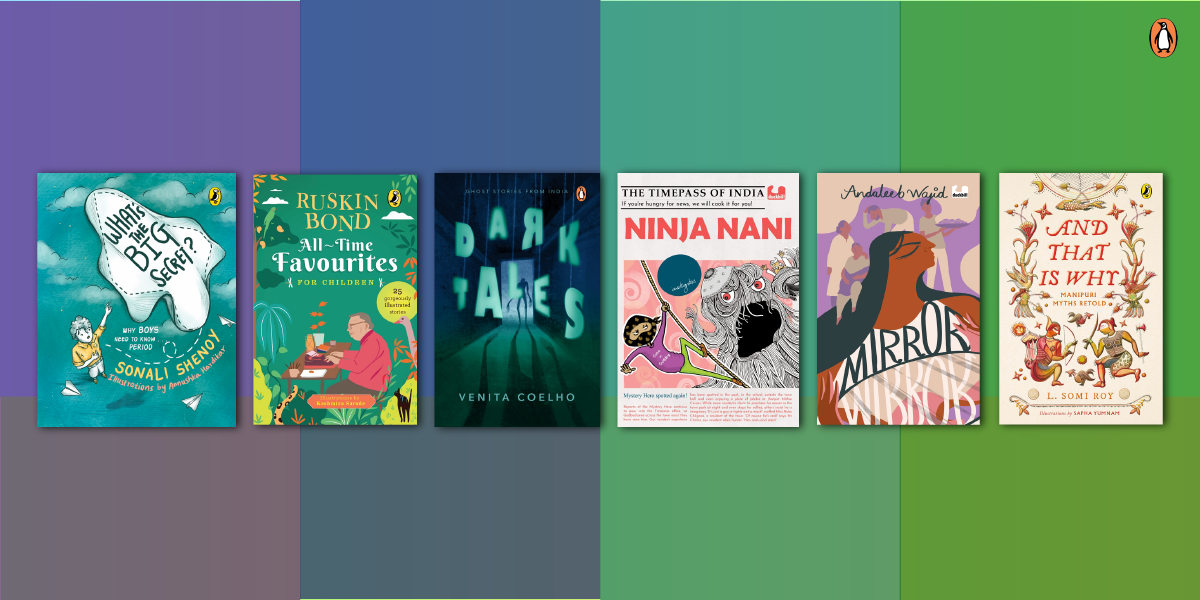
All-Time Favourites for Children
Ruskin Bond
All-Time Favourites for Children || Ruskin Bond, Kashmira Sarode (Illustrator)
Ages: 9+ years
All Time Favourites for Children celebrates Ruskin Bond’s writing with stories that are perennially loved and can now be enjoyed in a single collectible volume. Curated and selected by India’s most loved writer, this collection brings some of the evocative episodes from Ruskin’s life, iconic Rusty, eccentric Uncle Ken, ubiquitous grandmother, and many other charming, endearing characters in a single volume while also introducing us to a smattering of new ones that are sure to be firm favourites with young readers.
Ninja Nani and the Freaky Food Festival
Lavanya Karthik
Ninja Nani and the Freaky Food Festival || Lavanya Karthik
Ages: 10 to 14 years
It’s time for the annual festival and a special guest is expected to arrive in Gadbadnagar, but has a certain President gone too far? Has Nani finally met her match in the meanest, scariest and awfullest demon ever to crawl out of the Dark Forest? Will the Mayor’s mustache ever run for office?
Wait, there’s more!
Fake Mystery Heroes! Haunted falooda! Giant dogs–
And what’s that again about goats? You’re going to have to read it for yourself.
Mirror, Mirror
Andaleeb Wajid
Mirror, Mirror || Andaleeb Wajid
Ages: 10 to 14 years
Five years earlier, a friend’s nasty comment makes Ananya start hating her body. She decides to change into a new person-one who effortlessly fits into all kinds of clothes, who shuns food unless it’s salad, and who can never be called ‘Miss Piggy’-and to cut everything from her ‘old’ life, including her best friend, Raghu, for being the witness to her humiliation.
Ananya is on her way to becoming the Ananya of her dreams, but she’s still a work in progress.
One day, her parents announce that they’re expecting a baby (at their age!). To make matters worse, Raghu reappears in her life …
Andaleeb Wajid’s latest novel for young adults is a touching and funny story about a young girl’s journey to acceptance and self-love.
What’s the Big Secret?
Sonali Shenoy
What’s the Big Secret? || Sonali Shenoy, Annushka Hardikar (Illustrator)
Ages: 9+ years
Eleven-year-old Aditya really wants to know about periods.
Ever since Rhea Didi began getting brown paper packages, there’s been something that no one is telling him. Mama turns red, Pa chokes on his coffee and Dadi has steam coming out of her ears! Thank goodness for his friends Naveen and Vinay-whom he can talk to.
But when Vinay brings an odd-looking napkin to school that soaks ink, Aditya is even more confused. Doesn’t his sister use a microtip pen?
All of this is only making little Aditya more determined to find out What is going on!
Dark Tales
Venita Coehlo
Dark Tales || Venita Coehlo
Ages: 9+ years
In this collection of eleven very dark and twisted tales, Venita Coelho lays bare the underbelly of contemporary India. Get ready to gasp and cringe in horror as you have the rug pulled out from under you! This is a book you won’t want to read after dark.
And That is Why
L. Somi Roy
And That is Why || L. Somi Roy, Sapha Yumnam (Illustrator)
Ages: 8+ years
Dear Reader, do you know
· why the deer does not eat rice?
· why man gets wrinkles and a stoop?
· why the cat buries its poop?
· why a doll is worshipped in a village called Kakching?
Discover twelve magical tales from Manipur, the mountain land in the north-east of India on the border with Myanmar. Passed down by learned scholars, balladeers and grandmothers over hundreds of years, these unknown myths and fables are enriched with beautifully rich paintings that will transport you to Manipur!
‘Travel far, pay no fare…A book can take you anywhere.’
– Anne Morrow Lindbergh
The portal to the rest of the world is closer to you than you think. While we advise you to physically stay at home, no one said anything about not travelling!
Penguin Random House India brings to you the #PenguinStayList – a list of books that will inform, educate and entertain you as best as they can during this pandemic. Travel around the Indian coast, up to the greatest city of the Himalayas or even to different corners of the world.
‘That’s the thing about books. They let you travel without moving your feet.’
– Jhumpa Lahiri
Following Fish : Travels around the Indian Coast
In a coastline as long and diverse as India’s, fish inhabit the heart of many worlds food of course, but also culture, commerce, sport, history and society. Journeying along the edge of the peninsula, Samanth Subramanian reports upon a kaleidoscope of extraordinary stories. Throughout his travels, Subramanian observes the cosmopolitanism and diverse influences absorbed by India’s coastal societies, the withdrawing of traditional fishermen from their craft, the corresponding growth of fishing as pure and voluminous commerce, and the degradation of waters and beaches from over-fishing.
Don’t Ask Any Old Bloke For Directions – A Biker’s Whimsical Journey Across India
After twenty years in the Indian Administrative Service, P.G. Tenzing throws off the staid life of a bureaucrat to roar across India on an Enfield Thunderbird, travelling light with his possessions strapped on the back of his bike. On the nine-month motorcycle journey without a pre-planned route or direction, he encounters acquaintances who appear to be from his karmic past: from the roadside barber to numerous waiters and mechanics― fleeting human interactions and connections that seem pre-ordained.
If It’s Monday It Must Be Madurai: A Conducted Tour Of India
This book was first written when author Srinath Perur made the mistake of going on a conducted tour of ten of the most famous sites in India. However, despite being very annoyed at his bovine compatriots and his sonorous tour-guide, he found that there was some merit in traveling in groups, and wrote down his experiences in the form of this book. Witty, Humorous, and insightful, it combines his science-based knowledge and heartfelt experiences to create a tableau of interesting descriptions and adventures.
Shooting Star, The: A Girl, Her Backpack and the World
Shivya Nath quit her corporate job at age twenty-three to travel the world. She gave up her home and the need for a permanent address, sold most of her possessions and embarked on a nomadic journey that has taken her everywhere from remote Himalayan villages to the Amazon rainforests of Ecuador. Along the way, she lived with an indigenous Mayan community in Guatemala, hiked alone in the Ecuadorian Andes, got mugged in Costa Rica, swam across the border from Costa Rica to Panama, slept under a meteor shower in the cracked salt desert of Gujarat and learnt to conquer her deepest fears.
Travel Gods Must Be Crazy, The: Wacky Encounters in Exotic Lands
Dreaming of glorious sunrises and architectural marvels in exotic places, Sudha often landed up in situations that were uproariously bizarre or downright dangerous. Tongue firmly in cheek, she recounts her journeys through the raw wildernesses of Borneo and the African savannah, into the deserts of Iran and Uzbekistan, and up the Annapurna and the Pamirs, revealing the quirky side of solo travel to side-splitting effect. Punctuating her droll stories with breathtaking descriptions and stunning photographs, Sudha invites readers on an unexpected and altogether memorable tour around the world!
Kathmandu
Kathmandu is the greatest city of the Himalayas a unique survival of cultural practices that died out in India 1000 years ago. It is a carnival of sexual license and hypocrisy, a jewel of world art, a hotbed of communist revolution, a paradigm of failed democracy, a case study in bungled Western intervention and an environmental catastrophe.
Kathmandu follows the author’s story over a decade in the city and unravels the city’s history through successive reinventions of itself. Erudite, entertaining and accessible, this is the distinctive chronicle of a fascinating city.
From Heaven Lake
Hitch-hiking, walking, slogging through rivers and across leech-ridden hills, Vikram Seth travelled through Sinkiang and Tibet to Nepal: from Heaven Lake to the Himalayas, By breaking away from the reliable routes of organized travel, he transformed his journey into an unusual and intriguing exploration of one of the world’s least-known areas.
The Other Side of the Divide
Pegged on journalist Sameer Arshad Khatlani’s visit to Pakistan, this book provides insights into the country beyond what we already know about it. These include details on the impact of India’s soft power, thanks to Bollywood, and the remnants of Pakistan’s multireligious past, and how it frittered away advantages of impressive growth in the first three decades of its existence by embracing religious conservatism.
The book attempts to present a contemporary portrait of Pakistan-where prohibition remains only on paper and one of the biggest taxpayers is a Parsee-owned brewery-as a complicated and conflicted country suspended between tradition and modernity.
Well, that’s our list. Where will you travel to first?
Satyajit Ray hardly needs an introduction. Regarded as one of the greatest film-makers of our times, he received the Oscar for Lifetime Achievement by the Academy of Motion Picture Arts and Sciences in 1992 and was honoured with the Bharat Ratna in the same year.
He was also an ace designer, illustrator, music composer and to celebrate 100 years of the man, we share a list of books by him you’re bound to love, whether you’re new to his work, or are a long-term appreciator.
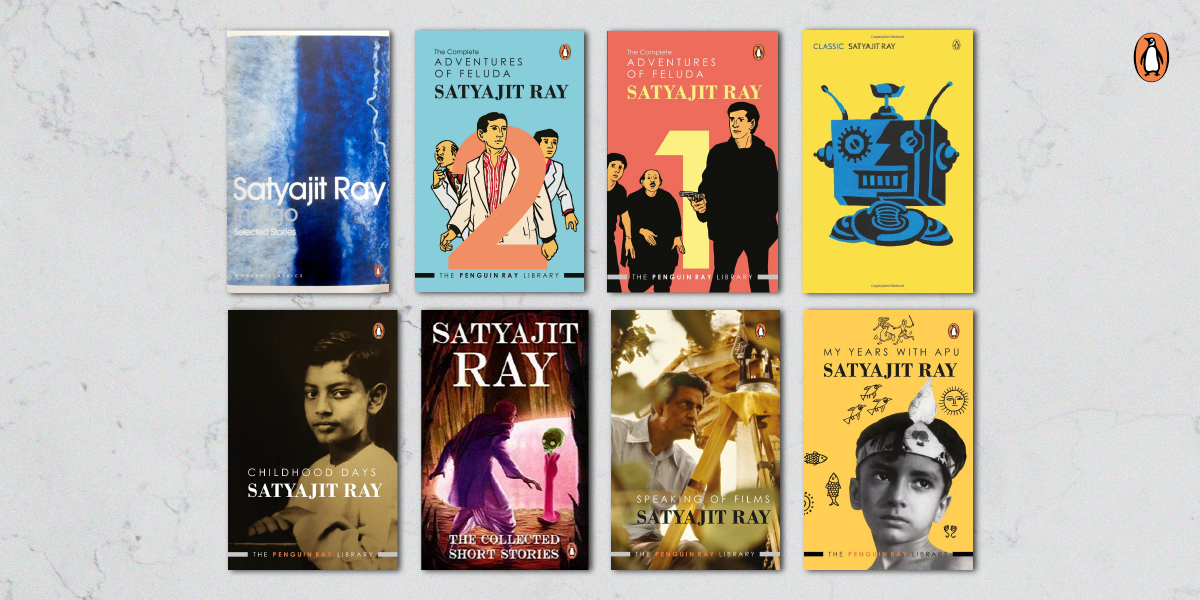
Childhood Days
Childhood Days | | Satyajit Ray
Childhood Days is a biography of Satyajit Ray, which he wrote on his own. Through this book, readers will come to know about the people who were around him during his childhood years, where he spent the early years of his life and who Satyajit Ray was, the man who we now know as an artist, music composer, director and writer. This book enables readers to take a look at a different side of Satyajit Ray, which is affectionate, tender and humorous, quite different from the person everyone knows, who is a serious man who keeps himself isolated from the world.
Classic Satyajit Ray
Ray’s short stories often explore the macabre and the supernatural, and Gopa Majumdar marked by the Translated from the Bengali by the author and are sharp characterization and trademark wit that characterizes his films. Cover illustration by Isa Esai This collection brings together Ray’s best short stories – including such read more timeless gems as ‘Khagam’, ‘Indigo’, ‘Fritz’, ‘Bhuto’, ‘The Pterodactyl’s Egg’, ‘Big Bill’, ‘Patol Babu, Film Star’ and ‘The Hungry Septopus’ – which readers of all ages will enjoy.
The Collected Short Stories (City Plans)
Best known for his immensely popular Feluda mysteries and the adventures of Professor Shonku, Satyajit Ray was also one of the most skilful short story writers of his generation. Ray’s short stories often explore the macabre and the supernatural, and are marked by the sharp characterization and trademark wit that distinguishes his films. This collection brings together Ray’s best short stories—including such timeless gems as ‘Khagam’, ‘Indigo’, ‘Fritz’, ‘Bhuto’, ‘The Pterodactyl’s Egg’, ‘Big Bill’, ‘Patol Babu, Film Star’ and ‘The Hungry Septopus’—which readers of all ages will enjoy.
My Years With Apu
The Indian film-maker Satyajit Ray tells the story behind the making of his three films, the “Apu” trilogy. Completed shortly before his death, the memoir covers the key aspects of his career: his decision to give up a lucrative job in advertising in order to make his first film, early setbacks, a chronic shortage of funds, the guidance and support of directors such as Jean Renoir, his solutions to problems, and the acclaim for his films at home and abroad.
Speaking of Films
Exactly fifty years ago, in 1955, the release of Pather Panchali heralded the arrival of a master in the world of cinema. Over the next forty years, Satyajit Ray came to be regarded as one of the world’s finest film-makers ever. Speaking of Films brings together some of Ray’s most memorable writings on film and film-making. With the masterly precision and clarity that characterize his films, Ray discusses a wide array of subjects: the structure and language of cinema with special reference to his adaptations of Tagore and Bibhuti Bhushan Bandopadhyay, the appropriate use of background music and dialogue in films, the relationship between a film-maker and a film critic, and important developments in cinema like the advent of sound and color. He also writes about his own experiences, the challenges of working with rank amateurs, and the innovations called for when making a film in the face of technological, financial and logistical constraints.
Indigo
Spine-tingling tales from the other side of midnight. Indigo is the mood in this new collection of stories about the supernatural, the peculiar and the inexplicable from Satyajit Ray, one of the best-loved writers of our times. There are tales here of dark horror, fantasy and adventure along with heartwarmingly funny stories about ordinary people in extraordinary situations. Indigo is a veritable treasure trove especially for those who like a taste of the unusual in a short story and an unexpected twist at the end. Translated from the Bengali by the author and Gopa Majumdar.
The Complete Adventures of Feluda Vol. 1
This omnibus edition features the ever-popular adventures of Satyajit Ray’s enduring creation, the professional sleuth Pradosh C. Mitter (Feluda). In his escapades, Feluda is accompanied by his cousin Topshe and the bumbling crime writer Lalmohan Ganguly (Jatayu). From Jaisalmer to Simla, from the Ellora Caves to Varanasi, the trio traverse fascinating locales to unravel one devious crime after another.
The Complete Adventures of Feluda Vol. 2
For readers who enjoyed The Adventures of Feluda in Volume 1, this second omnibus volume holds more delights. Accompanied by his cousin Topshe and the bumbling crime writer Lalmohan Ganguly (Jatayu), Feluda travels from Puri to Kedarnath, from Kathmandu to London in his pursuit of culprits; he tracks down Napoleon’s last letter, a forgotten painting by Tintoretto and a stolen manuscript.
India is one of the largest economies in the world yet when one goes to the grassroots to study the situation of the average Indian, one sees abject poverty and systemic inefficiency. Why is that, and what can we do?
Penguin Random House India has put together a list of titles by some of the most successful businessmen and economists in the country. With insights, experiences, tips, and the best way to move forward, there is sure to be something useful for you, and your business, and how your business can positively impact the country.
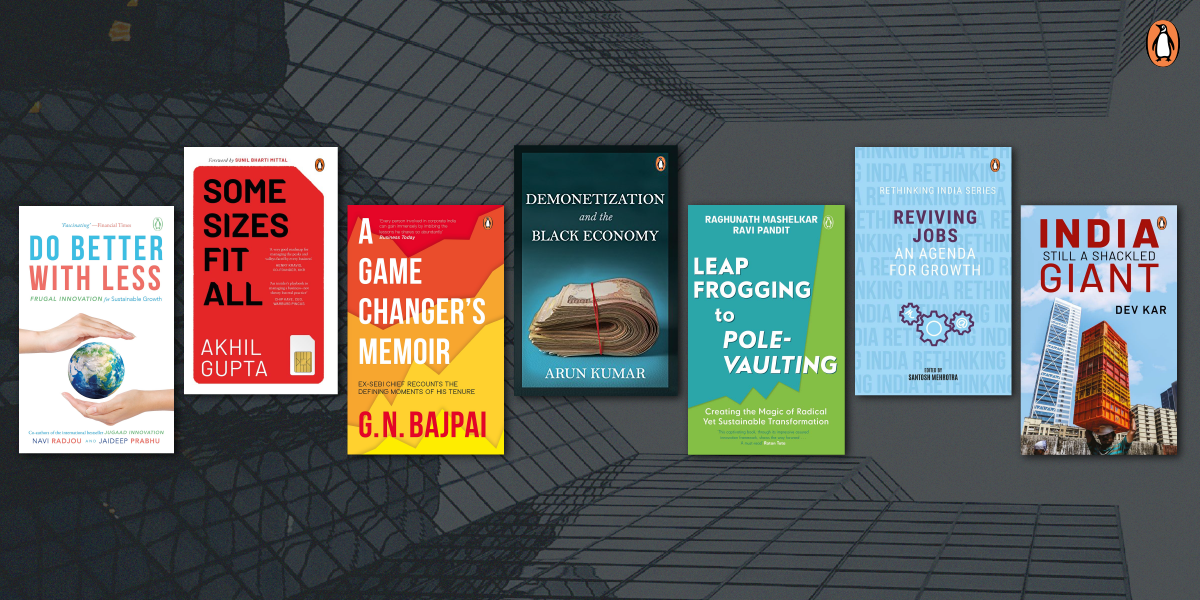
A Game Changer’s Memoir
A masterful strategist, Life Insurance Corporation of India (LIC) Chairman, G.N.Bajpai, in this book, recounts his truly inspiring journey as he weaved through complex rules and frameworks in his efforts to turn SEBI into an effective financial regulator for the country. Easy-flowing and readable with the writer’s anecdotal and educative style of writing and yet greatly comprehensive, this is a go-to book for a new generation of aspiring financial groundbreakers.
India: Still a Shackled Giant
India is one of the largest economies in the world today…but what about the India that the government does not want you to know about: the India where healthcare doesn’t work, corruption is rampant, criminals get elected to public office, the rich go scot-free, most people don’t pay income taxes and inequality is out of control.
Dev Kar, a former senior economist at the International Monetary Fund, points out the truth behind the noise of popular media and jingoism of leaders and tells us why India continues to be a shackled giant and how it can find the road to redemption.
Demonetization and the Black Economy
This move, it was claimed, was made to wipe out corruption, deter the generation of black money, weed out fake Indian currency notes and curb terrorism. Overnight, people in India realized that the cash in their pockets had no value. A year later, the RBI announced that 99 per cent of the old currency notes had been deposited with it. India continues to grapple with the effects of this move. The black economy has not been dented; counterfeiting and terrorism continue; the credibility of the RBI, banks and currency is damaged; the accountability of the Parliament and the prime minister has been eroded; and the social divide has widened. There have been many arguments and counter-arguments from both sides, but they have missed the complete picture.
Reviving Jobs: An Agenda for Growth
Every country in the world experiences the benefits of its demographic dividend, a period that comes but once in the life of a nation-when the share of the working-age population is larger than the non-working-age share. It has the potential to make a country progress towards higher incomes and development. But it can also become a nightmare if there aren’t enough jobs.
Reviving Jobs, the third volume in the Rethinking India series, offers suggestions on how India can make the best use of the remaining period of its demographic dividend-any failure to do so will cause millions to suffer in poverty for decades to come.
Do Better with Less: Frugal Innovation for Sustainable Growth
This groundbreaking book, by the bestselling authors of Jugaad Innovation, shows how India can harness the three megatrends — the sharing economy, the maker movement and the circular economy — and disruptive technologies such as AI and 3D printing to generate jobs and drive inclusive and sustainable growth in the decades to come.
Packed with over fifty case studies, Do Better with Less offers six proven principles that Indian entrepreneurs and businesses can use to co-create frugal solutions in education, energy, healthcare, food and finance that are highly relevant to India and the world.
Leap Grogging to Pole-Vaulting
An exhilarating manifesto for the future, this book convinces readers to make the shift from reactive leapfrogging to proactive pole-vaulting through radical transformation.
The unique ‘3-4-7 framework’ demonstrates how a paralysing mass of problems can be brought down to a formidable formula, thus making every problem solvable, no matter how big and complex. The book is dotted with inspiring case studies that can instil confidence in people from across the world to put this framework into practice for assured success.
Some Sizes Fit All
Some Sizes Fit All is an attempt to explain these fundamental pillars for any kind of business. An authentic and lucid presentation of management concepts and practices-which Akhil Gupta has tried and tested first hand through his illustrious career-this is a must-read for anyone trying to build a robust and financially sound business.
As days get longer and warmer, we find ourselves cooped up in our homes, avoiding the scorching heat and that deadly virus no one should name. But time indoors doesn’t have to feel like a chore necessarily, thanks to our age-old friends—books.
Here’s a list of refreshing reads to keep you engrossed and entertained through the long, sunny days of April.
**
Queen of Fire
Devika Rangachari
Queen of Fire || Devika Rangachari
Lakshmibai, the widowed queen of Jhansi, is determined to protect her son’s right to his father’s throne and safeguard the welfare of her kingdom. Faced with machinations to take over Jhansi, at a time when all of India is rising up against the British, she has to prove her valour and sagacity time and again. But will this be enough to save all that she values?
In this gripping novel, award-winning historical novelist Devika Rangachari brings to vivid life the interior life of this nineteenth-century queen, thrust into a position she does not desire but must assume, and of her son, who is cowed by the challenges he has to face but determined to live up to his mother’s courage.
Satyajit Ray in 100 Anecdotes
Arthy Muthanna Singh, Mamta Nainy
Satyajit Ray in 100 Anecdotes || Arthy Muthanna Singh, Mamta Nainy
Tracing his magnificent life with 100 little-known and inspiring incidents as well as unusual trivia, this collectible edition pays homage to the maestro on his 100th birth anniversary.
A master filmmaker, a remarkable auteur, a writer par excellence and an artist of immense reach and range, Satyajit Ray was an indefinable genius. This book is a classic tribute that celebrates his many accomplishments across literature, music, art and more.
Another Dozen Stories
Satyajit Ray
Another Dozen Stories || Satyajit Ray
Another Dozen Stories brings to you the magical, bizarre, spooky and sometimes astonishing worlds created by Satyajit Ray, featuring an extraordinary bunch of characters!
While ‘The McKenzie Fruit’ trails a humble man trying to leave his mark in history, ‘Worthless’ is a moving story about a seemingly hapless character not quite able to win the confidence of his family. Meet Professor Hijibijbij, the eccentric scientist bent on creating living replicas of peculiar creatures and follow Master Angshuman into a nail-biting and unexpected adventure on the sets of his very first film. This collection includes twelve hair-raising stories that will leave you asking for more!
Jamlo Walks
Samina Mishra
Jamlo Walks || Samina Mishra
It is day 7 of the lockdown and everyone says the skies are blue again. Jamlo walks. She looks straight at the road ahead. It is long.
The world has stood still. The streets lie empty and schools are closed. All work has dried up and people keep whispering the word ‘corona’ all the time. Jamlo walks down a long and hot road, alongside hundreds of other men and women and children whom Tara sees on TV. Jamlo walks as Rahul watches the streets turn quiet.
Jamlo walks and walks in a world that needs to be kind and just and equal. A world where all lives are seen as important.
Sita’s Chitwan
Vaishali Shroff
Sita’s Chitwan || Vaishali Shroff
As big as 1,78,000 football fields, Nepal’s first protected national park is home to over 550 species of birds; awe-inspiring animals, such as greater one-horned rhinoceroses, Bengal tigers, clouded leopards; and a confident, brave girl called Sita.
Sita dreams of being a nature guide like her baba. With a spring in her step and a group of eager tourists, she unravels the secrets of the forest. But when she wanders astray and comes face to face with a mamma rhino, will this eight-year-old be able to listen to the stillness of the jungle?
The Astoundingly True Adventures of Daydreamer Dev
Ken Spillman
The Astoundingly True Adventures of Daydreamer Dev || Ken Spillman
Forever daydreaming-that’s Dev. Sitting in class or watching the clouds from the roof of Kwality Carpets, he floats off to places all over the world and has wonderful, bizarre adventures.
Mild-mannered schoolboy Dev is no stranger to survival in extreme environments. Classroom trances and home-made flights of fancy take him all over the place-what other kid could have visited Amazon rainforests, summited Mount Everest and crossed the Sahara? Along with the challenges of all this, he also needs to avoid the wrath of teachers and make Amma and Baba proud . . . Not so easy when your brain lives elsewhere!
The Bournvita Quiz Contest Quiz Collector’s Edition, Vol. 1
Derek O’Brien
The Bournvita Quiz Contest Quiz Collector’s Edition || Derek O’Brien
The award-winning Bournvita Quiz Contest started as a radio programme in 1972, then shifted to television in the 1990s. Since 1994, it has been hosted by Asia’s best-known quizmaster, Derek O’Brien, in his inimitable style, and it holds the record for being the longest-running knowledge game show on Indian television.
This definitive edition comprises a selection of the best Q & As from this iconic children’s show. Featuring 1000 questions, carefully curated from the exhaustive twenty-year-old archives, this book is dotted with heartening anecdotes, fun trivia and thoughtful essays by people who worked on this much-loved show.
The Bournvita Quiz Contest Quiz Collector’s Edition, Vol. 2
Derek O’Brien
The Bournvita Quiz Contest Quiz Collector’s Edition || Derek O’Brien
Which Nobel laureate wrote articles under the name Gul Makai?
Hilsa is the national fish of which neighbouring country of India?
In which organ of the human body would you find the aqueous humour?
With fun Q&As carefully curated from the exhaustive twenty-year-old archives, this definitive book is a treat for all quiz aficionados who can choose from an array of fifty sections including:
Art and Culture
Science
Politics
Mythology
Books and Authors
It isn’t always easy to be a woman. As our little girls grow up, we’d love to have them mentored by some of the strong women, with strong voices who aren’t always brought to the limelight. There is so much the women before us have done to bring us where we are – and it’s important we teach our girls – and boys – that women are as strong as men….if not stronger.
Here is a list of books for children to celebrate women, this Women’s Day
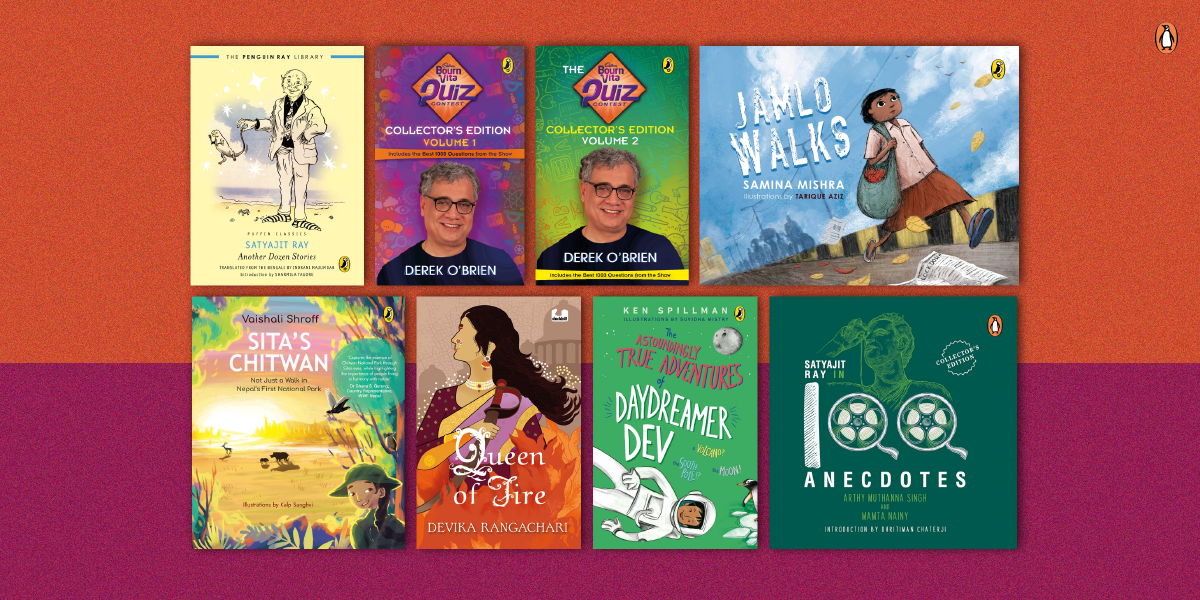
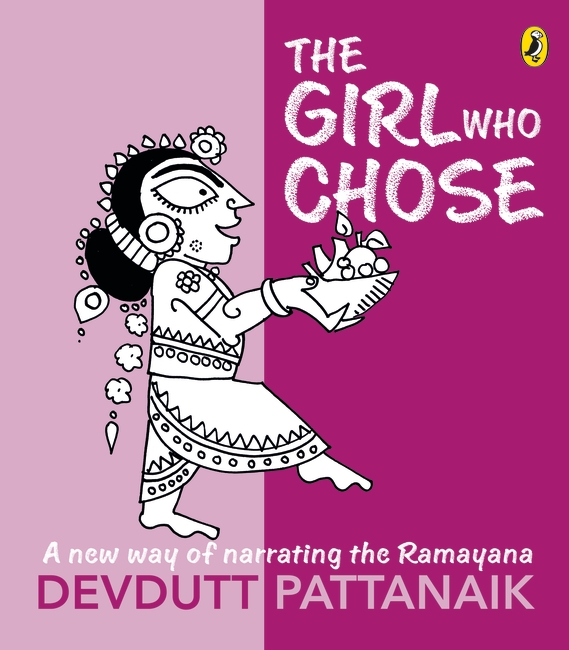
The Girl Who Chose by Devdutt Pattnaik
‘You are bound by rules, but not I. I am free to choose.’
Two thousand years ago, the poet-sage Valmiki wrote the Ramayana. It is the tale of Ram, the sun-prince of Ayodhya, who is obliged to follow family rules and so makes no choices.
India’s favourite mythologist brings you this charmingly illustrated retelling of the Ramayana that is sure to empower and entertain a new generation readers.
The Daughter from a Wishing Tree by Sudha Murty
The women in Indian mythology might be fewer in number, but their stories of strength and mystery in the pages of ancient texts and epics are many. They slayed demons and protected their devotees fiercely. From Parvati to Ashokasundari and from Bhamati to Mandodari, this collection features enchanting and fearless women who frequently led wars on behalf of the gods, were the backbone of their families and makers of their own destinies.
I Need to Pee by Neha Singh
Rahi simply loves slurping refreshing drinks, and so she always needs to pee. But boy, does she hate public loos! Travel with the cheeky Rahi and read all about her yucky, icky, sticky adventures in this quirky and vibrant book about the ever-relevant worry of having a safe and clean toilet experience.
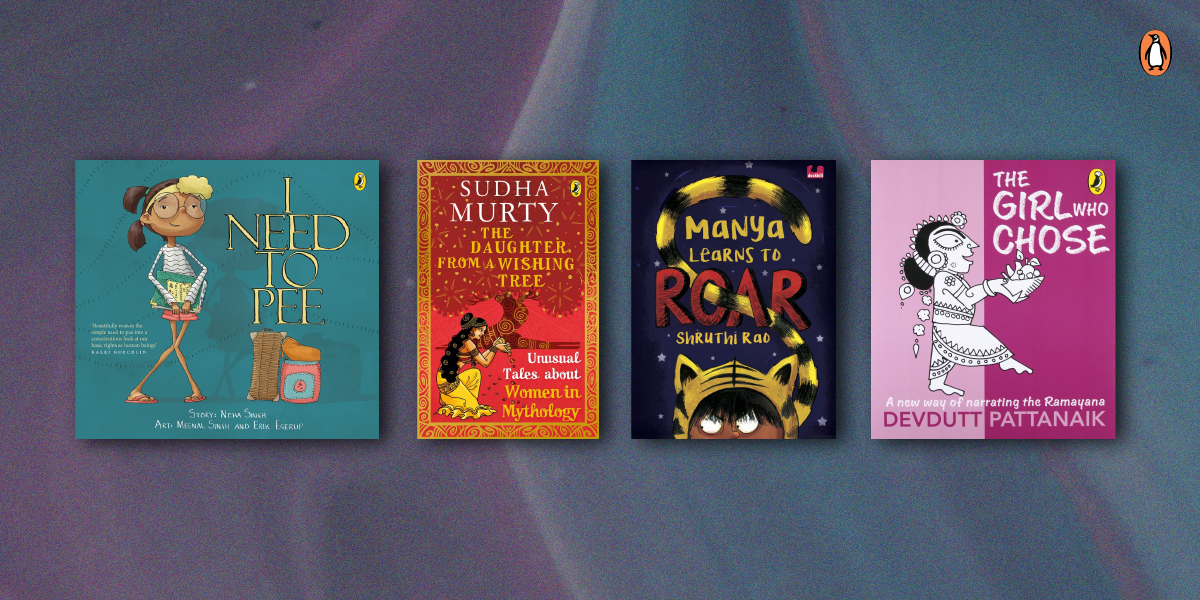
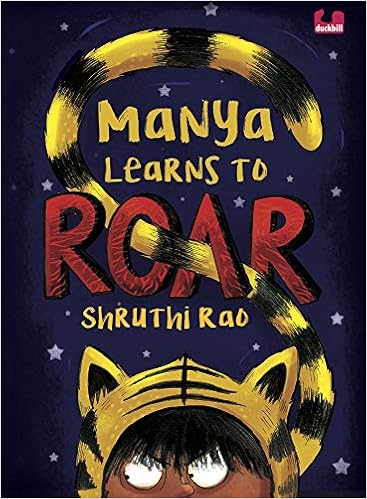
Manya Learns To Roar by Shruthi Rao
Manya badly, badly wants to be Shere Khan in her school play. The Jungle Book is her favourite film and she knows all the lines. She’s sure she’ll be a superb Shere Khan.
But not everyone thinks so. Her classmate Rajat is always making fun of her stammer. Her English teacher thinks its risky to let her get on stage and her principal seems to agree.
The more anxious Manya gets, the worse her stammer becomes. Will Manya lose her dream role? Can she overcome her fears and learn to roar?
What do the strong women we know, go through to become who they are? What goes on behind the scenes – and what makes a woman strong?
Many of them have fought to bring the world where it is today. And we must continue to be inspired by them so we can continue their paths and legacy’s. Here is a list of books of strong women with strong voices, to inspire you, this Women’s Day
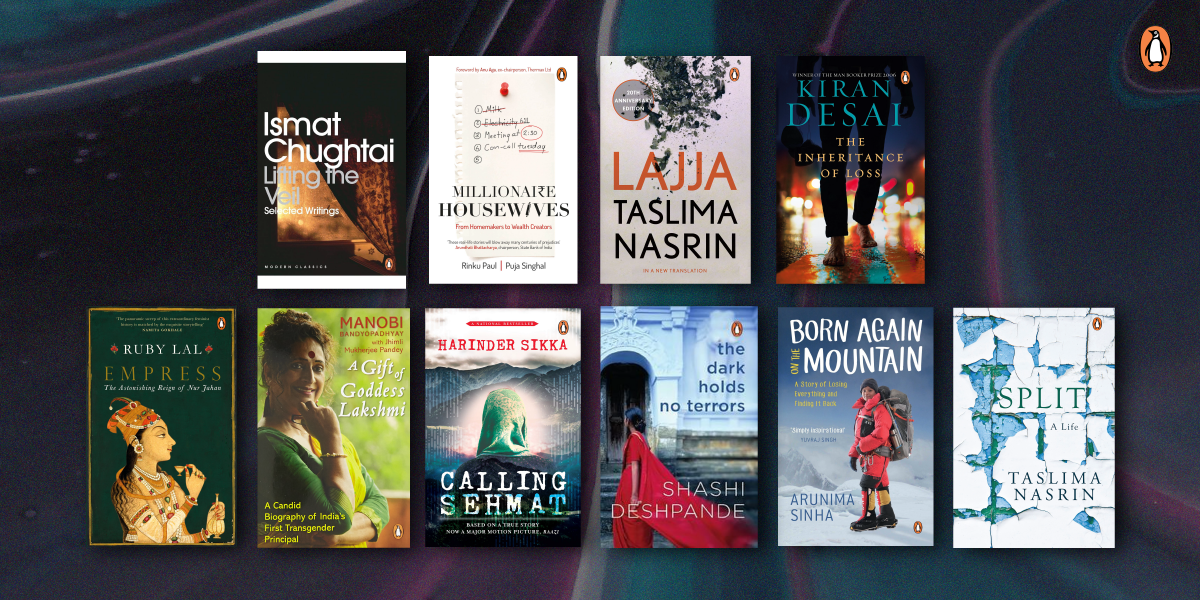
Lajja by Taslima Nasrin
A savage indictment of religious extremism and man’s inhumanity to man, Lajja was banned in Bangladesh but became a bestseller in the rest of the world. This brand-new translation marks the twentieth anniversary of this controversial novel. The Dattas Sudhamoy and Kironmoyee and their children, Suronjon and Maya have lived in Bangladesh all their lives. Despite being members of a small Hindu community that is terrorized at every opportunity by Muslim fundamentalists, they refuse to leave their country, unlike most of their friends and relatives.
*
Split by Taslima Nasrin
Taslima Nasrin is known for her powerful writing on women’s rights and uncompromising criticism of religious fundamentalism. This defiance on her part had led to the ban on the Bengali original of this book by the Left Front in West Bengal as well as the Government of Bangladesh in 2003. While the West Bengal government lifted the injunction after the ban was struck down by the Calcutta High Court in 2005, Nasrin was eventually driven out of Kolkata and forced to expunge passages from the book, besides facing a four-million-dollar defamation lawsuit. Bold and evocative, Split: A Life opens a window to the experiences and works of one of the bravest writers of our times.
*
The Dark Holds No Terrors by Shashi Deshpande
‘Why are you still alive-why didn’t you die?’
Years on, Sarita still remembers her mother’s bitter words uttered when as a little girl she was unable to save her younger brother from drowning. Now, her mother is dead and Sarita returns to the family home, ostensibly to take care of her father, but in reality to escape the nightmarish brutality her husband inflicts on her every night. In the quiet of her old father’s company Sarita reflects on the events of her life: her stultifying small town childhood, her domineering mother, her marriage to the charismatic young poet Mahohar.
*
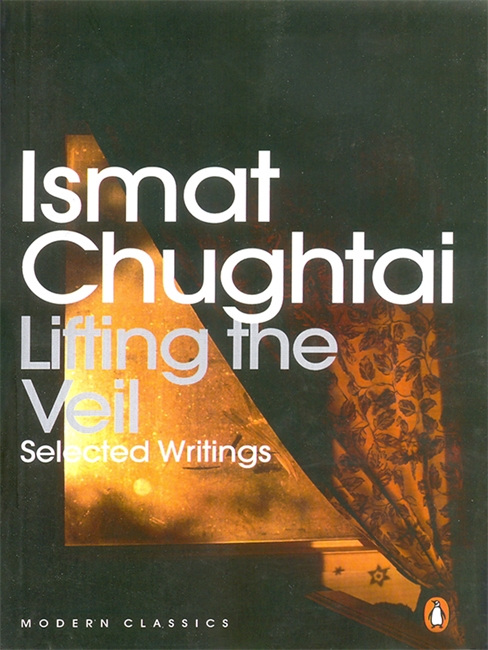
Lifting the Veil by Ismat Chughtai
At a time when writing by and about women was rare and tentative, Chughtai explored female sexuality with unparalleled frankness and examined the political and social mores of her time. She wrote about the world that she knew, bringing the idiom of the middle class to Urdu prose, and totally transformed the complexion of Urdu fiction. Lifting the Veil brings together Ismat Chughtai’s fiction and non-fiction writing. The twenty-one pieces in this selection are Chughtai at her best, marked by her brilliant turn of phrase, scintillating dialogue and wry humor, her characteristic irreverence, wit and eye for detail.
*
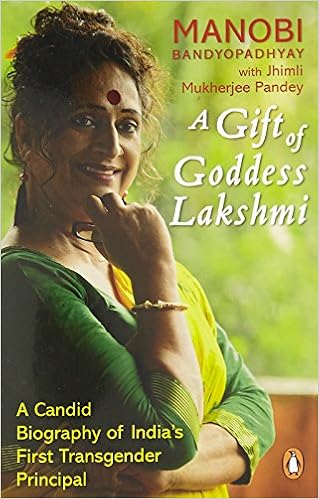
A Gift of Goddess Lakshmi by Manobi Bandopadhyay
The extraordinary and courageous journey of a transgender to define her identity and set new standards of achievement.
With unflinching honesty and deep understanding, Manobi tells the moving story of her transformation from a man to a woman; about how she continued to pursue her academics despite the severe upheavals and went on to become the first transgender principal of a girls’ college. And in doing so, she did not just define her own identity, but also inspired her entire community.
*
Empress by Ruby Lal
Acclaimed historian Ruby Lal uncovers the rich life and world of Nur Jahan, rescuing this dazzling figure from patriarchal and orientalist cliches of romance and intrigue, while giving a new insight into the lives of the women and the girls during the Mughal Empire, even where scholars claim there are no sources. Nur’s confident assertion of authority and talent is revelatory. In Empress, she finally receives her due in a deeply researched and evocative biography that awakens us to a fascinating history.
*
The Inheritance of Loss by Kiran Desai
In a crumbling, isolated house at the foot of Mount Kanchenjunga in the Himalayas lives an embittered judge who wants only to retire in peace, when his orphaned granddaughter, Sai, arrives on his doorstep. The judge’s cook watches over her distractedly, for his thoughts are often on his son, Biju, who is hopscotching from one gritty New York restaurant to another. Kiran Desai’s brilliant novel, published to huge acclaim, is a story of joy and despair. Her characters face numerous choices that majestically illuminate the consequences of colonialism as it collides with the modern world.
*
Calling Sehmat by Harinder Sikka
When a young college-going Kashmiri girl, Sehmat, gets to know her dying father’s last wish, she can do little but surrender to his passion and patriotism and follow the path he has so painstakingly laid out. It is the beginning of her transformation from an ordinary girl into a deadly spy.
She’s then married off to the son of a well-connected Pakistani general, and her mission is to regularly pass information to the Indian intelligence. Something she does with extreme courage and bravado, till she stumbles on information that could destroy the naval might of her beloved country.
*
Born Again on the mountain
National-level volleyball player Arunima Sinha had a promising future ahead of her. Then one day she was shoved from a moving train by thieves as she attempted to fight them off. The horrific accident cost the twenty-four-year-old her left leg, but it never deterred her. A year later, she had retrained as a mountaineer and become the first female amputee to reach Mount Everest. This is her unforgettable story of hope, courage and resilience.
*
Millionaire Housewives by Rinku Paul | Puja Singhal
Millionaire Housewives tells the stories of twelve enterprising homemakers who, in spite of having no prior experience in business, managed to build successful empires through the single-minded pursuit of their goal, defying all stereotypes. Amidst their varied motivations and struggles, Millionaire Housewives offers valuable lessons for homemakers who want to venture into entrepreneurship.
The Constitution of India came into effect on 26th January, 1950. As we celebrate India’s 72nd Republic Day, let’s dig deeper to understand the journey till this day in 1950, and our journey since then.
Here is a list of books from various authors, including Abhinav Chandrachud, Ramachandra Guha, Khushwant Singh, Sagarika Ghosh, K.R. Narayanan and many more! What’s more, there are titles for the little ones as well!
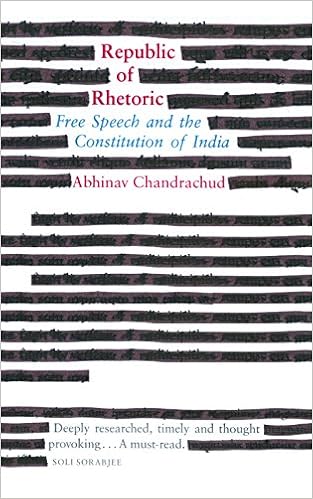
Republic of Rhetoric || Abhinav Chandrachud
Exploring socio-political as well as legal history of India, from the British period to the present, this book brings to light the idea of ‘free speech’ or what is popularly known as the freedom expression in the country. Analysing the present law relating to obscenity and free speech, this book will evaluate whether the enactment of the Constitution made a significant difference to the right to free speech in India. Deeply researched, authoritative and anecdotal, this book offers arguments that have not been substantially advanced before.
*
How India Became Democratic || Ornit Shani
How India Became Democratic explores the greatest experiment in democratic human history. It tells the untold story of the preparation of the electoral roll on the basis of universal adult franchise in the world’s largest democracy. Ornit Shani offers a new view of the institutionalisation of democracy in India, and of the way democracy captured the political imagination of its diverse peoples.
*
Makers of Modern India || Ramachandra Guha
Makers of Modern India is a detailed source for information about the country’s political traditions. The republic of India had a very tumultuous beginning and the author shows you how 19 political activists were instrumental in the evolution of this country. The author goes beyond a description of the people by including extracts of the speeches they have written. Each phase of the freedom movement and the following years of independent India are shown through the written works produced by these 19 individuals.
*
Democrats and Dissenters || Ramachandra Guha
A major new collection of essays by Ramachandra Guha, Democrats and Dissenters is a work of rigorous scholarship on topics of compelling contemporary interest, written with elegance and wit.
The book covers a wide range of themes: from the varying national projects of India’s neighbours to political debates within India itself, from the responsibilities of writers to the complex relationship between democracy and violence.
*
The Idea Of India || Sunil Khilnani
This long essay makes an eloquent and persuasive argument for Nehru’s idea of nationhood in India. At a time when the relevance of Nehru’s vision is under scrutiny, this book assumes a special significance.
*
The Discovery of India || Jawaharlal Nehru
Jawaharlal Nehru wrote the book The Discovery of India, during his imprisonment at Ahmednagar fort for participating in the Quit India Movement (1942 – 1946). The book was written during Nehru’s four years of confinement to solitude in prison and is his way of paying an homage to his beloved country and its rich culture.
*
India’s Legal System || Fali S Nariman
India has the second-largest legal profession in the world, but the systemic delays and chronic impediments of its judicial system inspire little confidence in the common person. In India’s Legal System, renowned constitutional expert and senior Supreme Court lawyer Fali S. Nariman looks for possible reasons. While realistically appraising the criminal justice system and the performance of legal practitioners, he elaborates aspects of contemporary practice, such as public interest litigation, judicial review and activism.
*
The Case That Shook India || Prashant Bhushan
On 12 June 1975, for the first time in independent India’s history, the election of a prime minister was set aside by a high court judgment. The watershed case, Indira Gandhi v. Raj Narain, acted as the catalyst for the imposition of the Emergency. Based on detailed notes of the court proceedings, The Case That Shook India is both a significant legal and a historical document.
*
The Great Repression || Chitranshul Sinha
The Indian Penal Code was formulated in 1860, three years after the first Indian revolt for independence. Where did this law come from? How did it evolve? And what place does it have in a mature democracy? Concise, incisive and thoughtful, The Great Repression by Chitranshul Sinha, an advocate on record of the Supreme Court of India, tells the story of this outdated colonial-era law.
*
The Burden Of Democracy || Pratap Bhanu Mehta
After nearly seven decades of its existence, there is a pervasive feeling that India’s democracy is in crisis. But what is the nature of this threat? In this essay, republished now with a new foreword from the author, Pratap Bhanu Mehtare minds us what a bold experiment bringing democracy to a largely illiterate and unpropertied India was.
Optimistic, lively and closely argued, The Burden of Democracy offers a new ideological imagination that throws light on our discontents. By returning to the basics of democracy it serves to illuminate our predicament, even while perceiving the broad contours for change.
*
The End Of India || Khushwant Singh
Analysing the communal violence in Gujarat in 2002, the anti-Sikh riots of 1984, the burning of Graham Staines and his children, the targeted killings by terrorists in Punjab and Kashmir, Khushwant Singh forces us to confront the absolute corruption of religion that has made us among the most brutal people on earth. He also points out that fundamentalism has less to do with religion than with politics. And communal politics, he reminds us, is only the most visible of the demons we have nurtured and let loose upon ourselves.
*
India’s Struggle For Independence || Bipin Chandra & Others
India’s Struggle for Independence by Bipin Chandra is your go to book for an in-depth and detailed overview on Indian independence movement . Indian freedom struggle is one of the most important parts of its history. A lot has been written and said about it, but there still remains a gap. Rarely do we get to hear accounts of the independence from the entire country and not just one region at one place. This book fits in perfectly in this gap and also provides a narration on the impact this movement had on the people.
*
Why I Am a Liberal || Sagarika Ghose
The stamping out of difference, the quelling of diversity and the burial of argument is, in fact, most un-Indian. Anyone who seeks to end that dialogue process is ignoring Indianness and patriotism. The liberal Indian argues for the rights of the marginalized in the tradition of Gandhi for trust, mutual understanding and bridge-building. Real patriotism lies in old-fashioned ideas of accommodation, friendship and generosity; not in force, muscle flexing and dominance. Why I Am a Liberal is Sagarika Ghose’s impassioned meditation on why India needs to be liberal.
*
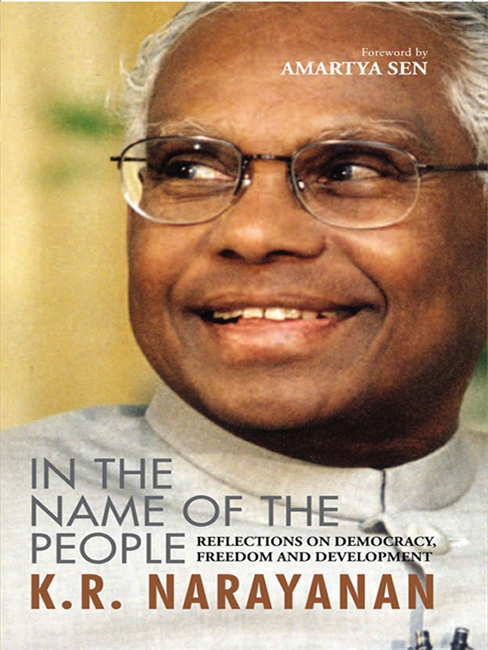
In The Name Of The People || K R Narayanan
In the Name of the People brings together K.R.Narayanan’s most important writings spanning five decades, from his first published article in 1954 to the Republic Day speech of 2000. In these pieces, he covers a diverse range of topics, from Indo–US ties and India–China relations to human development, Islam in India and women in politics; from the benefits of the parliamentary system and the need to build democracy from the grassroots to the role of education and technology in development and the importance of a sustainable environment.
*
Vichhoda || Harinder Sikka
Bibi Amrit Kaur’s life is literally torn apart in the 1947 riots. She’s now in a different country with a different identity. She accepts this new life gracefully and begins a new chapter. She gets married and has two children. Life, however, has something else in store for her. It breaks her apart. Again.
This time the pain is unbearable.
But the hope that she will reunite with her children and be whole again keeps her alive. And she doesn’t let the bitterness cloud her days, becoming a beacon of hope and courage for all.
From the bestselling author of Calling Sehmat comes another hitherto untold story of strength, sacrifice and resilience.
*
Sixteen Stormy Days || Tripurdaman Singh
Sixteen Stormy Days narrates the riveting story of the First Amendment to the Constitution of India-one of the pivotal events in Indian political and constitutional history, and its first great battle of ideas. Drawing on parliamentary debates, press reports, judicial pronouncements, official correspondence and existing scholarship, Sixteen Stormy Days challenges conventional wisdom on iconic figures such as Jawaharlal Nehru, B.R. Ambedkar, Rajendra Prasad, Sardar Patel and Shyama Prasad Mookerji, and lays bare the vast gulf between the liberal promise of India’s Constitution and the authoritarian impulses of her first government.
*
Ambedkar’s Preamble || Aakash Singh Rathore
Although Dr Ambedkar is universally regarded as the chief architect of the Constitution, the specifics of his role as chairman of the Drafting Committee are not widely discussed. Totally neglected is his almost single-handed authorship of the Constitution’s Preamble, which is frequently and mistakenly attributed to B.N. Rau rather than to Ambedkar.
This book establishes how and why the Preamble to the Constitution of India is essentially an Ambedkarite preamble.
*
Vision For A Nation || Ashish Nandy, Aakash Singh Rathore
What is the nation? What is the idea of India? Whose India is it, anyway?
This inaugural volume in the series titled Rethinking India aims to kickstart a national dialogue on the key questions of our times. It brings together India’s foremost intellectuals, academics, activists, technocrats, professionals and policymakers to offer an in-depth exploration of these issues, deriving from their long-standing work, experience and unflinching commitment to the collective idea of India, of who we can and ought to be. Vision for a Nation: Paths and Perspectives champions a plural, inclusive, just, equitable and prosperous India, committed to individual dignity as the foundation of the unity and vibrancy of the nation.
Let’s not leave the children out! Here is a list of books for your children.
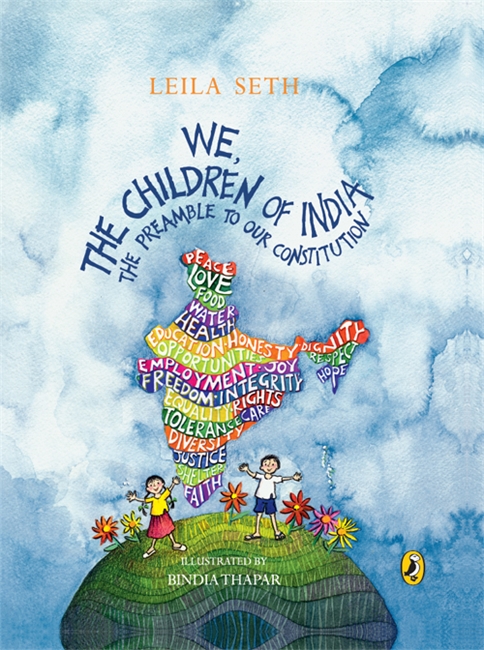
We The Children Of India || LeIla Seth
Former Chief Justice Leila Seth makes the words of the Preamble to the Constitution understandable to even the youngest reader. What is a democratic republic, why are we secular, what is sovereignty? Believing that it is never too early for young people to learn about the Constitution, she tackles these concepts and explains them in a manner everyone can grasp and enjoy. Accompanied by numerous photographs, captivating and inspiring illustrations by acclaimed illustrator Bindia Thapar, and delightful bits of trivia, We, the Children of India is essential reading for every young citizen.
*
The Constitution Of India For Children || Subhadra Sen Gupta
Every 26th January, people gather on New Delhi’s Rajpath amidst a colourful jamboree of fluttering flags, marching soldiers and dancing children. What is celebrated on this day is at the heart of our democracy-the magnificent Constitution of India.
The document didn’t only lay down the law but united India with a vision that took two years, eleven months and seventeen days to realise. Subhadra Sen Gupta captures the many momentous occasions in Indian history that led to its making in The Constitution of India for Children. Populated with facts and dotted with cheerful illustrations, this book provides answers to innumerable questions asked over the years.
*
The Puffin History Of India (Vol.1) || Roshen DalalThe Puffin History Of India (Vol. 2) || Roshen Dalal
These books trace the fascinating story of the social, political, cultural and economic development across the high points of Indian history-from the earliest times to the British conquest, the Nationalist movement and, finally, the triumph of Independence. The informal, engaging style and the colourful descriptions of people, events and cultures provide a comprehensive picture of what life was like in India up to 1947. Informative, well researched and containing a host of illustrations and maps, this amazing reference guide helps bring the past to life for students and young readers like never before.
*
India A To Z
What was India’s very own desi dino called? How did India’s currency come to be named the rupee? Which Indian glacier is the highest battleground in the world? Who wrote the world’s first grammar book? If questions like these make you curious about incredible India, here is a bumper info-pedia packed with fascinating facts, terrific trivia and colourful cartoons on just about everything in India, this book encourages interest in a wide range of subjects.
*
My India || A.P.J Abdul Kalam
My India: Ideas for the Future is a collection of excerpts from Dr A.P.J. Abdul Kalam’s speeches in his post presidency years. Drawn from Dr Kalam’s addresses to parliaments, universities, schools and other institutions in India and abroad, they include his ideas on science, nation-building, poverty, compassion and self-confidence.




 Cricket for the Crocodile


 Earthquake