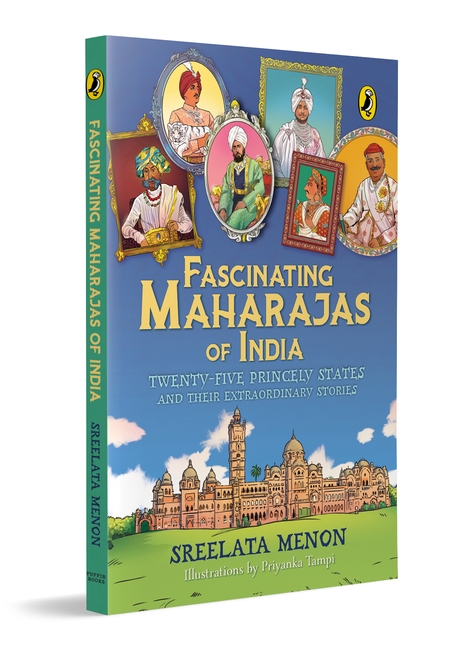
Long, long ago, the vast Indian subcontinent was alive with powerful kingdoms and adventurous maharajas. They expanded with fervour and ruled with aplomb. They lived extravagant lives yet protected their turfs. They introduced reforms and uplifted their people. And despite their many quirks, they laid the foundation for the progress and development of modern India.
- How did the Travancore maharajas promote education?
- When did the Mysore maharajas begin celebrating Dasara with such pomp?
- How unique was the Junagadh nawab’s love for his dogs?
Discover the answers to these questions and more in this gorgeously illustrated book that chronicles twenty-five such exciting Indian kingdoms—from their origin to when they became princely states under the British to finally merging with the Indian Union at the time of Independence and becoming the backbone of a brand-new nation.

Gandhi was 20th century’s most acclaimed political thinker-practioner of nonviolence. His method of nonviolence, however, was under trial during the ferocity of Partition. Why was it so? Gandhi: The End of Nonviolence explores this crisis in depth.
Putting Gandhi center stage in significant political events ranging from the Khilafat Movement (1919-1922) to Partition (1946-1947), Manash Firaq Bhattacharjee critically engages with some of the key figures who had a stake on the Hindu-Muslim question: Maulana Mohamad Ali, Muhammad Iqbal, the Arya Samajists, B.R. Ambedkar, Swami Vivekananda, Sri Aurobindo and Vinayak Damodar Savarkar.
The tragic repercussions of Jinnah’s declaration of ‘Direct Action Day’ on 16th August 1946 leads Manash to ask probing questions on the persistent malady in our political history: How does communal politics descend into genocide? What is the psychology of communal violence? Attentively reading the exceptional witness accounts of Pyarelal, Nirmal Kumar Bose and Manu Gandhi, Manash throws light on the many shades of Gandhi’s epic peace mission as he walks (often barefoot) through the devastated neighbourhoods of Noakhali, Bihar, Calcutta and Delhi, offering courage and healing wounds.
Combining poetic flair, diligent research and argumentative rigour, this one-of-a-kind book reminds us why Gandhi is part of our ethical conscience and transforms our understanding of the human condition.
Transform Your Life with Powerful Rituals and Practices
Are you ready to tap into the universe’s energy and manifest your dreams? The beliefs and rituals shared in this book are designed to unlock your personal growth by dispelling limiting beliefs that have been programmed into your mind, preventing you from realizing your true potential.
This book is a must-read for anyone looking to elevate their journey, understand the power of the universe, and create a life filled with purpose and positivity.
What You Will Discover Inside:
- Manifestation Tools: Learn proven techniques to manifest your deepest desires with the power of intention.
- Daily Rituals: Simple, actionable rituals to integrate manifestation into your everyday routine for a happier, more fulfilling life.
- Personal Growth: Boost your self-awareness, unlock your potential, and discover tools for constant personal development.
Why You Need This Book:
- Ideal for fans of manifestation, astrology, and personal development.
- A practical guide with clear, easy-to-follow steps for immediate results.
- Transform your mind, body, and spirit with the guidance of renowned astrology expert Deepanshu Giri.
Whether you’re new to manifestation or a seasoned practitioner, Rituals of a Happy Soul will empower you to connect with the universe, overcome obstacles, and manifest your best life.
Start your journey toward a happier, more fulfilled life today!

Neil Ramamurthy, an Indian-origin American DJ, reaches Delhi on his first trip to India. His only objective is to win back his girlfriend, Sameera, after she broke his heart in New York City on New Year’s Eve several months ago.
Sameera Kapoor is busy launching her club, Kapital, which has been shuttered since her mother dropped dead in it five years ago. Safe to say, a relationship’s not on her mind.
The way to Sameera’s heart is through her club – and its smooth launch – but as luck would have it, the road to Kapital’s launch is marred with bizarre incidents. And when everything seems to have returned to normal, an accidental death in the club sends Neil and Sameera’s world crashing down. To make matters worse, the officer-in-charge, Inspector KK, seems hell bent on making things harder for them.
As Neil maneuvers through these challenges, he finds himself entangled in a ludicrous love triangle, one which may or may not be responsible for the events at Kapital.
Who knew being a DJ came with such a huge occupational hazard?
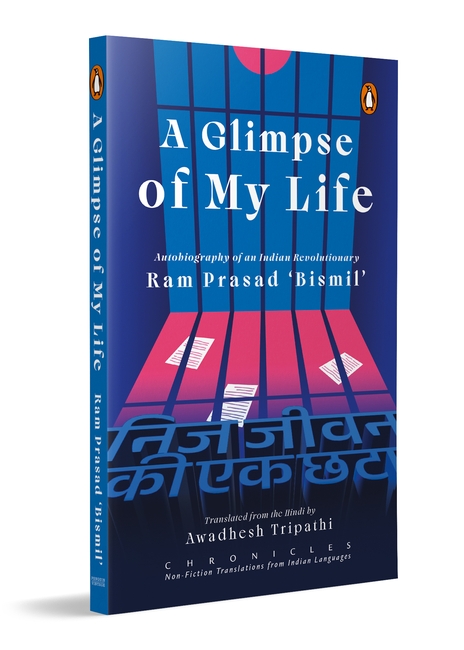
Ram Prasad ‘Bismil’ (1897-1927) remains among the best-known revolutionaries of India’s struggle for freedom. In this autobiography, Bismil reflects on his life, as well as on the people and ideas that inspired him, and on the revolutionary movement he built. He remembers his childhood, the hardships his parents faced, the role his mother and guru played in shaping him, his involvement in the Kakori train robbery, his experiences in prison, and his comrades fighting alongside him for freedom from British rule.
Bismil not only offers glimpses of his eventful life but also lays out his ideas on gender, caste, class, communalism, justice, nation-building and the attractions and pitfalls of revolutionary activity. The readers of his autobiography will find many of these ideas to be of great relevance in present-day India.
Originally titled Nij Jiwan Ki Chhata, this book was written in secret during Bismil’s imprisonment, while he was on death row. It is a passionately narrated account of the life of a young and daring freedom fighter who lived and died with the single aim of freeing India from foreign rule.
A young student in pre-Independence Dacca, Ranajit Dutta is relatively untouched by the patriotic fervour gripping the rest of the country. He is suffocated by and often critical of, the constricted environment and superstition ridden society he lives in. He seeks an escape through poetry and his search for the embodiment of universal womanhood. But one event shakes up his idealism and fundamentally changes his relationships with the women in his life: his first love Mitu Bardhan; his affectionate but neglected aunt Kajol; his revolutionary friend Bulbul; his naive, adoring wife Nalini. A man’s perennial quest for the unattainable, Black Rose also brings alive the heady idealism and the charged years when India was struggling to be free.

Easily one of the most towering figures of Bengali literature of the twentieth century, Buddhadev Bose was as prolific as he was versatile. A poet of renown, Bose was also an accomplished playwright, novelist, essayist and short-story writer. His prose is marked by invention, refreshing modernity and an easy yet deep engagement with timeless themes: love, the nature of memory, and the complexity of the relationship between man and woman—qualities which keep Bose’s work enduringly relevant.
This collection brings together ten stories and two one-act plays which embody all of these qualities. In ‘The Love Letter’, Birupaksha Ray, a translator and a linguist, receives a ciphered missive from an old flame, unlocking which could occupy the rest of his life; in ‘A Scent of Tulsi’, Mihir, a husband comfortable in his patriarchy discovers a side to his wife, Kamala, which shakes up his world. And, in ‘Twenty-five Years After—or Before’, a one-act play, old lovers meet by chance at an international airport and talk about opportunities missed, and those not taken.
Translated by Arunava Sinha with trademark flair and accuracy, Restless Was the Night and Other Stories demonstrates why Buddhadev Bose occupies such a premier position in Bengali literature. This volume will appeal to Bose’s fans as well as to all lovers of great fiction.

Nattukotai Chettiars were the most prominent business community from Tamil region and this book captures their spirit of enterprise that led many of them to seek their fortunes overseas. It’s a story that connects South India, Burma, and South-East Asia across the Bay of Bengal and equally one that spans the British imperial era and that of the modern nation state.
For students of history, business, and for modern entrepreneurs, the book has valuable lessons on the importance of diversifying into promising investment opportunities and gauging the economic winds of change.

Having worked all his life, Shivaswamy eagerly awaits the serenity of retirement. But his plans are suddenly upturned when his attempts to buy a house are scuppered by unscrupulous builders. Suddenly, he realizes that he might have to join the workforce again. What follows is a tale of gentle satire that is also an intense human drama. Shivaswamy faces the toughest choice, one that threatens the values that have sustained him throughout his life.
Set in contemporary Bengaluru, What’s Your Price, Mr Shivaswamy? is an elegantly crafted and deeply engaging story about a man torn between material necessities and spiritual aspirations. How much would you sacrifice for some peace of mind?
Translated into English by the author himself, this novel was originally published in Kannada as Ondondu Talegu Ondondu Bele .
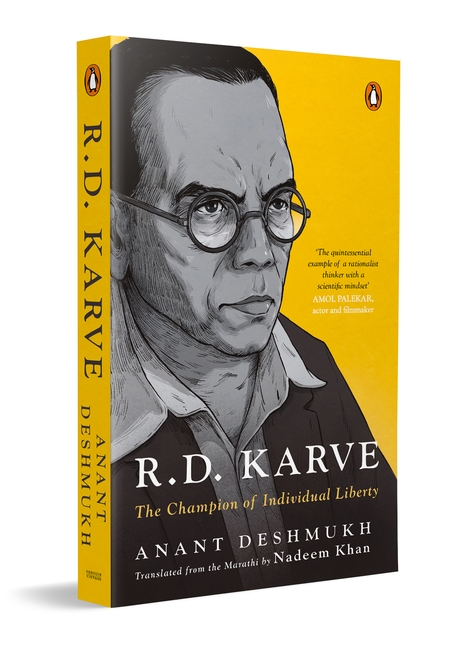
Raghunath Dhondo Karve was among the stormy and controversial figures of his time in Maharashtra. Born to Dhondo Keshav Karve, a social reformer who advocated for women’s rights and widow remarriage, RD Karve studied the subjects of birth control and the science of lovemaking. In 1927, Raghunath started the Samaaj Sawaasthya (Health of the Society) magazine in Marathi. The thoughts he propagated through this magazine were too radical for the society of his time and the orthodoxy who often raised obstacles and filed several cases against him. Originally written in Marathi by Dr Anant Deshmukh, and translated by Nadeem Khan, RD Karve: The Champion of Individual Liberty is a meticulously researched biography of a reformer and a social criticism of the times.