



Uttara Rao, Janaki Paranjape, Arvind Shah, K. Subba Rao and Sumitra Iyer first cross each other’s paths at Indian Institute of Science, Bangalore, in 1999. Coming from vividly different backgrounds, the five soon became friends. As they navigate relationships, careers and life, they vow to come back to the campus twenty-five years later. A story of hardships, perseverance, success and disappointment, the book examines the lives of five friends as they look back and reminisce on how life turned out. Life has indeed come to a full circle for them. Inspirational and poignant, The Circle of Life is a moving story of five friends as they deal with life’s great expectations.
Archives: Books
The Owl, the River, the Valley
In Arupa Patangia Kalita’s stories, contemporary women in Assam take centerstage. The deeply lyrical and empathetic stories talk about issues like surrogacy, migration, living in a colonial legacy, employment, and history—all of which affect women in the region today.
In Mitra Phukan’s nuanced translation, the region and its people come alive. A deeply compelling and satisfying collection for lovers of contemporary fiction, The Owl, the River, the Valley is a deeply compelling journey into Assam.
The Turbulent Waters of Climate Action
In this timely and incisive book, Stephen Groff explores the intricate challenges facing political leaders in developed nations as they confront the global climate crisis. Through a deep analysis of media influence, political agendas, and societal priorities, the book uncovers the barriers that often stall meaningful climate action and slow the momentum toward real change.
Groff expertly examines how public trust, media narratives, and entrenched political structures shape policy decisions. An essential read for policymakers, environmental advocates, and citizens alike, The Turbulent Waters of Climate Action is both a call to action and a roadmap for creating more effective climate governance.
Father Tongue, Motherland
How do languages mix? Does it begin in chaos, new migrants and old inhabitants needing a pidgin to communicate? Or does it happen more smoothly, in stages? And what is a prakrit? Why do we hear only of prakrits, and never of pidgins, in South Asia?
In Father Tongue, Motherland, Peggy Mohan looks at exactly how the mixed languages in South Asia came to life. Like a flame moving from wick to wick in early encounters between male settlers and locals skilled at learning languages, the language would start to ‘go native’ as it spread. This produced ‘father tongues’, with words taken from the migrant men’s language, but grammars that preserved the earlier languages of the ‘motherland’.
Looking first at Dakkhini, spoken in the Deccan where north meets south, Mohan goes on to build an X-ray image of a vanished language of the Indus Valley Civilization from the ‘ancient bones’ visible in the modern languages of the area. In the east, she explores another migration of men 4000 years ago that left its mark on language beyond the Ganga-Yamuna confluence. How did the Dravidian people and their languages end up in south India? And what about Nepal, where men coming into the Kathmandu Valley 500 years ago created a hybrid eerily similar to what we find in the rest of the subcontinent?
One image running through this book is of something that remains even when the living form of language fades. Tucked away in how we think and speak now are echoes of our history, and the story of ancestors who lived hundreds and thousands of years ago.
Hands That Wrote History
A unique biography that explores and celebrates the life of one of India’s greatest calligraphers.
‘Every artist starts with shaky lines. With practice, these lines can turn into a masterpiece.’
Right from childhood, Prem loved to watch his dadaji’s pen glide across the page like a dancer on stage. It was as if his pen were a magic wand, breathing life into letters and making them bloom like fresh flowers.
Prem dreamed of mastering this magic and becoming a calligrapher, just like Dadaji. But when he tried, his
letters turned out wobbly, squiggly, and looked more like caterpillars.
Can Prem learn the language of letters and transform his uncertain lines into a masterpiece?
The New Icon
Did Savarkar battle a stormy sea when he attempted his legendary escape at Marseilles? Did Gandhiji and he stay together ‘as friends’ in London as Savarkar claimed during Gandhiji’s assassination trial? Did he turn against Muslims because of the cruelty of jailers in the Andamans? What is one to make of his ‘mercy petitions’ to the British? Did he pledge to be ‘politically useful’ to the British and accept conditions for his release that even the British had not demanded? During the Quit India movement, did Savarkar promise ‘whole-hearted cooperation’ to the British? What did he seek from the British? Was Savarkar the one who showed Subhas Bose the path that Netaji then followed?
What did Savarkar think of Hinduism, about our beliefs and ‘holy cows’, about the texts Hindus hold to be sacred? Have our people been suffused with Hindutva as Savarkar maintained? What sort of a State did he envisage? Is Savarkar being resurrected today to erase the one great inconvenience—Gandhiji?
In The New Icon, Arun Shourie delves deep into Savarkar’s books, essays, speeches, statements to answer these and other questions. He exhumes archives of the British government. He takes us through contemporary records. And unearths facts that will surprise you.
For No Reason At All
Based on true events, For No Reason at All captures the mood of the New Delhi administration, where its new, young prime minister must make a difficult decision.
In a time when global trade borders are opening, the reputable Metkem Silicon and the Indian Institute of Science, Bangalore, collaborate to produce silicon metal locally. But Anand Seshadri, the powerful head of the Department of Electronics pushes to import the technology from the US.
The ‘silicon metal controversy’ erupts, and the prime minister must decide: Support Indian innovation? Or concede to foreign imports?
When Seshadri takes drastic, underhanded measures to discredit Metkem Silicon, the task of countering him falls to Metkem’s lobbyist—a young, adroit lobbyist named Adityan ‘Solly’ Nilla.
Things get interesting when Solly receives an unexpected call from the embassy of the Soviet Union. And then the French and the Americans, and the Indian intelligence get involved.
Set in the New Delhi of the 1980s, this tale of espionage, intrigue, deception and sexual escapade is pacy, funny . . . and sometimes touching.
Roop and the River Crossing
Roop carries her newest toy—a kaleidoscope—everywhere. The world from her kaleidoscope looks split up . . . and so does her world. Around her, unfamiliar words echo: India. Pakistan. Partition. Home.
Words that sound distant from her reality, until one night changes everything. Roop finds herself at a riverbank, one that she must cross to find her home—her new home.
Award-winning author Samina Mishra tells a poignant tale of a dark chapter in history. Through Roop’s journey, she weaves a story of connections, resilience and finding an anchor in turbulent times.
Rising Sons
In pre-independent India, in the small village of Kesarugattu somewhere in Karnataka, Devaraya, a Brahmin, goes about further ossifying his status. This little hamlet, like every other, follows the said and unsaid rules of caste and religion. Inter-caste marriages are frowned upon. Brahmin and other wealthy upper caste men set the rules. The Ai tribes live far away from the village, in the forest. As societal divisions and unlikely friendships play out in the everyday life of the village, a secret from Devaraya’s past comes to haunt him and his family. The repercussions are huge for both Devaraya, his wife Gowru and his two sons Nanju and Anna.
Even as battle lines are drawn in the village and undeclared allies offer support, this fresh trouble claims one of his two sons. That’s not all – meanwhile, the Independence movement that infects the little hamlet sweeps away his other son in its fever. What is to become of the dreams Devaraya had for his sons?
Rising Sons, a novel in four parts, tells the delicate story of the relationship between fathers and sons, between husbands and wives, between family and society; of the fate of a small village that is tied to the making of a great nation; of the hope and promise of the young against the disappointments of the past; of the hows and whys of political life.
The Whispering Mountains: Greatest Himalayan Folktales
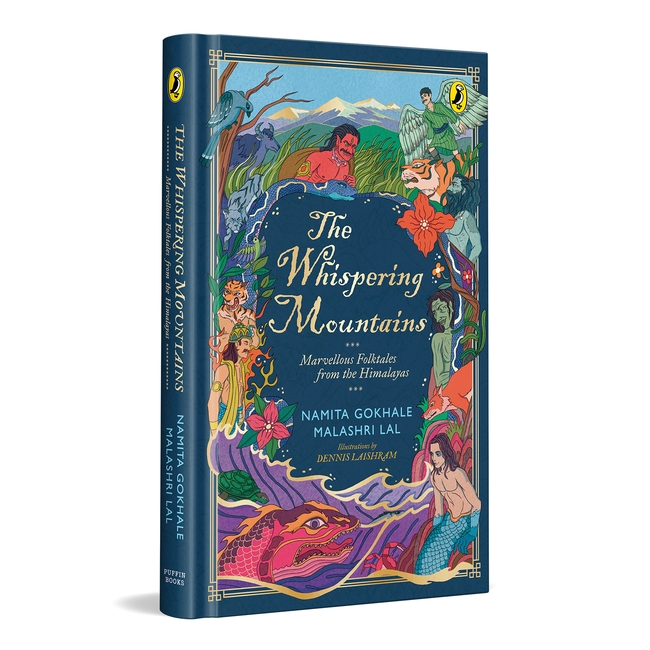
The Whispering Mountains: Marvellous Folktales from the Himalayas is a collection of folktales handed down through generations—tales shared by grandparents sitting by the fire on cold nights, tales carried by the whispering winds, and echoing through the rivers and peaks of the Himalayas.
In these tales, trees and flowers, animals and birds coexist with humans, one story ending as another one begins. The wicked and the good are not as they seem, and magic is always close at hand. Clever women outwit thieves, while fools reveal unexpected wisdom. The stories hold the teachings of nature and the playful mischief of tricksters, the marvel of creation myths, and the shimmering magic of shapeshifters. Across these regions lie the enduring secrets and strengths of the mountains, with doors that lead to hidden realms and windows which open to wonder.