




Renowned as a titan in global finance, Mark Mobius unveils a comprehensive guide to mastering the intricate landscape of financial investments. Drawing from his illustrious career spanning emerging markets and beyond, Mobius, with unparalleled expertise, demystifies the various financial instruments one can use to start their investing journey. From stocks and bonds to alternative assets, this book serves as an indispensable road map for understanding the diverse avenues of wealth creation. Dive into Mobius’s wealth of knowledge as he provides insightful descriptions and analyses of different investment tools, offering young investors a solid foundation for making informed financial decisions.
Archives: Books
Gendered Bodies and Worlds of Labour
This book presents a brilliant reading of the unanimous decision of the nine-judge bench of the Supreme Court of India in the case of Justice KS Puttaswamy (Retd.) and Another vs. Union of India and Others (‘Puttaswamy’). The 2017 judgment protects the right to privacy as
a fundamental right, and guarantees the right to life with dignity, the right to personal liberty and the right to move the court against unconstitutional actions by the state.
The authors examine the implications of Puttaswamy to understanding labouring bodies (in their multiplicity) and their worlds of work. They explore the gendered dimensions of the right to privacy and its relation to labour rights, sexual safety, and bodily integrity, offering a dynamic interpretation of the right to privacy and related rights of dignity, liberty, and equality. Using the Constitution, Kannabiran and Jagani anchor labour rights in Puttaswamy to advance claims-making and emphasise collective struggles for justice and resistance to oppression as the most productive route to conceptualising an idea of justice in the realms of labour.
Further, the monograph emphasises the need to popularise constitutional conversations beyond the courts and holds valuable lessons for women’s and labour rights movements. Drawing from a range of scholarly works and case law to offer a fresh understanding of labour that doesn’t rely on gender binaries, the authors initiate conversations on human dignity, intersectional discrimination, and resistance to reinstating labouring bodies in workplaces. This work opens up new opportunities for feminist and labour studies scholars, trade unions, and courts to explore interdisciplinary intersections and frame claims for more just, fair, and equal working environments.
Kalpana Kannabiran and Devi Jagani’s work inspires both hope and anxiety, as they challenge us to build intellectual and on-ground solidarities that cross disciplinary boundaries, to support those who are most marginalised.
— Navsharan Singh, independent researcher, writer, and activist
The Life and Work of Moovalur Ramamirtham Ammaiyar
Moovalur Ramamirtham Ammaiyar spent almost her entire life fighting against the devadasi system in Tamil Nadu, a practice that dedicated young girls to temples, where they were meant to be available for the sexual needs of priests and landowners. Sold off by her parents, and brought up to dedicate herself as a dasi, she managed to escape this fate and make a life for herself. Her battle against the devadasi system was met with considerable resistance, not only by those with vested interests in keeping the devadasis inside temples, but often by the devadasis themselves. But Moovalur persisted, taking her cause, and its wider ramifications into the broader politics of the Congress party, and later the Self-Respect Movement. Despite this, in the annals of recent Tamil history, she was hardly known, until the publication, in 2006 of Moovalur Ramamirtham: Vazhvum Paniyum (translated here as The Life and Work of Moovalur Ramamirtham Ammaiyar). Put together through interviews with her surviving relatives and fragments garnered from a handwritten manuscript, this is the first book to document the ‘braveheart’ of Dravidian history, Moovalur Ramamirtham Ammaiyar.
Why Would I Be Married Here?
Why Would I Be Married Here? examines marriage migration undertaken by rural bachelors in North India, unable to marry locally, who travel across the breadth of India seeking brides who do not share the same caste, ethnicity, language, or customs as themselves.
Combining rich ethnographic evidence with Dalit feminist and political economy frameworks, Reena Kukreja connects the macro- political violent process of neoliberalism to the micro-personal level of marriage and intimate gender relations to analyse the lived reality of this set of migrant brides in cross-region marriages among dominant-peasant caste Hindus and Meo Muslims in rural North India.
Why Would I Be Married Here? reveals how predatory capitalism links with patriarchy to dispossess many poor women from India’s marginalized Dalit and Muslim communities of marriage choices in their local communities. It reveals how, within the context of the increasing spread of capitalist relations, these women’s pragmatic cross-region migration for marriage needs to be reframed as an exercise of their agency that simultaneously exposes them to new forms of gender subordination and internal othering of caste discrimination and ethnocentrism in conjugal communities. Why Would I Be Married Here? offers powerful examples of how contemporary forces of neoliberalism reshape the structural oppressions compelling poor women from marginalized communities worldwide into making compromised choices about their bodies, their labour, and their lives.
The Feminisms of Our Mothers
In this remarkable collection of essays about their mothers, women from Pakistan explore the many meanings of feminism and its varying interpretations through generations. How, they ask, do these meanings change, mould, attract and detract within and between generations? How do women bridge the cracks that emerge in these formations as they hold within them the joys, sorrows, conflicts and contradictions of their multiple feminisms?
Intentional Health
A nurturing guide to whole-body health that completely integrates traditional Eastern and modern Western healing practices.
By combining a 5,000-year history rooted in time-tested, ancient traditions with cutting-edge science, Dr. Chiti Parikh, executive director of the Integrative Health and Wellbeing Program at New York-Presbyterian Hospital and a clinical professor at Weill Cornell Medical College, provides the steps you can take to bring your body into a lasting state of balance and live a longer life with more energy, less pain, and renewed confidence.
No matter where you are along your health journey, Dr. Chiti will help you achieve balance by letting you in on seven ancient secrets from circadian rhythms to the mind-body connection to digestive fire. With Dr. Chiti’s guidance, you too can become intentionally healthy by:
• Setting a positive health intention and visualizing how you’d like to feel
• Diving into ancient health principles
• Engaging in a 28-day vitality regimen to jump-start your journey to optimal health
• Becoming equipped with the knowledge to identify imbalances as soon as they occur
After all, health is not the mere absence of disease. Health is living a life full of energy and manifesting your true potential, with your body as your best ally.
Intentional Health offers a clear road map for self-regulating our biology for optimal health and longevity. What was once considered alternative medicine is now supported by advances in epigenetics and neuroplasticity. Our conscious choices and habits of thinking, feeling, and behavior can restore healing and make chronic illness optional. This book is an excellent guide for anyone seeking a joyful, energetic body, healthy emotions, clear mind, and lightness of being. – Deepak Chopra
Rethinking India: The Politics of the Marginalized
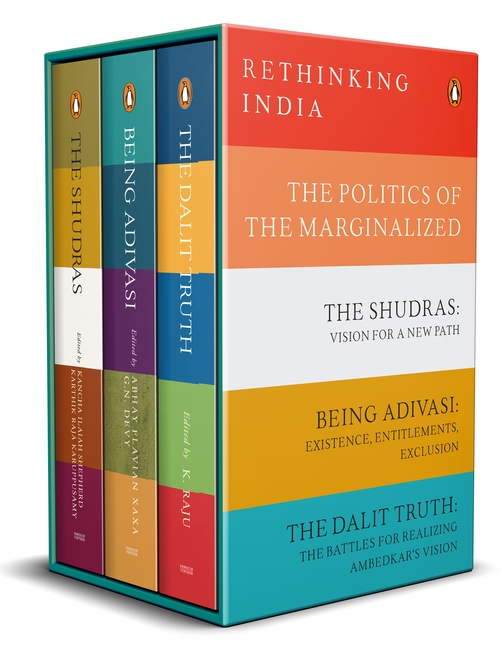
The Rethinking India series, spearheaded by the Samruddha Bharat Foundation and Penguin Random House India, objectively rethinks the current socio-economic, political and cultural paradigms, and poses disruptive ideas addressing structural problems. Leveraging the unique intellectual vantage points of India’s foremost thinkers and practitioners, the three books included in this box set critically reflect on the lived realities of the Dalit, Shudra, Adivasi and Denotified communities. Sensitively juxtaposing ‘what should have been’ with ‘what is’, the books propose a visionary blueprint that will both deepen and further India’s constitutional promise for these communities. This is a must-have set for politicians, policymakers, academics, activists, journalists, students and anyone working on issues of social justice, equality, fraternity, liberty and welfare in India.
The Naga Warriors 1
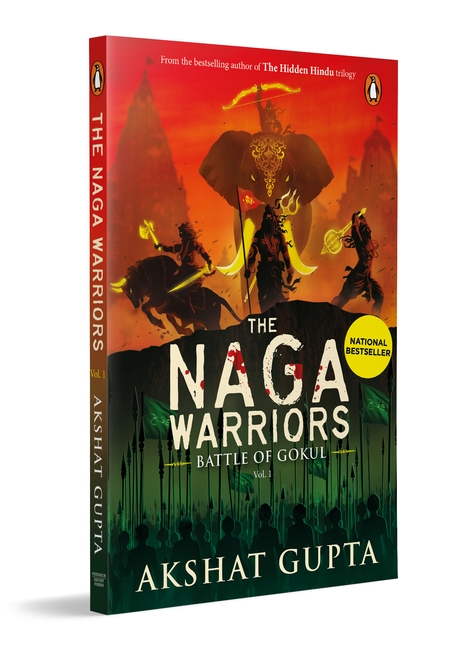
To prepare for the future, our ancestors created the Naga sadhus—a clan of warriors for the protection of Dharma, as proclaimed by Adi Guru Shankaracharya in the eighth century. This sect of Shiva devotees has stood firm, living selflessly and fighting fearlessly. For centuries, they have died the death of heroes, serving and saving Dharma and the temples.
In the year 1757, 111 Naga sadhus borrowed the majestic weapons of the idols of their gods. Fueled by their belief in Lord Shiva, they gathered an invincible courage to protect the temples of Gokul. They stood as an indestructible wall, led by Ajaa, a fearless Naga warrior, against the Afghan army of 4000 men, a cavalry of 200 horses and 100 camels, and 20 cannons. The brutal Afghan army was led by Sardar Khan, the most ruthless commander of Emperor Ahmed Shah Abdali, ill-famed for the demolition of temples and building a history of genocide in Bharat.
The fight continues. This is the Naga warrior’s commitment to courage and determination. This is the clash of Shiva devotees against the devils that lie under men’s skin. This is the Battle of Gokul.
370: Undoing the Unjust
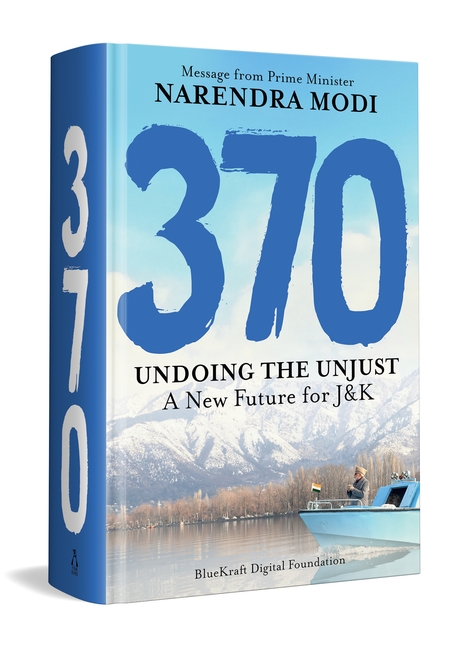
The most definitive account of how Article 370 was abrogated.
The inside story of how Prime Minister Narendra Modi turned the seemingly impossible into a reality.
An eye-opening read on the damage Article 370 inflicted on Jammu and Kashmir.
A book that will interest diverse readers, including students, scholars and historians.
Introduced in October 1949, Article 370 turned out to be a long-standing ‘permanent’ temporary provision till 5 August 2019, when it was abrogated by the Parliament of India. The article has been subjected to intense debate and much discussion over the years. Those who supported it cited Jammu and Kashmir’s unique situation in 1947, while those who opposed it questioned how one nation could have two constitutions, two flags and two sets of rules. The naysayers also questioned its reductive aspects—the denial of basic rights to the poor, scheduled caste and scheduled tribe communities, and women.
But whichever side one stood on, the conventional belief for sixty-five years since Independence was that Article 370 can never be repealed. But then came 5 August 2019, when the supposedly impossible became a reality.
370: Undoing the Unjust, A New Future for J&K takes the reader through the minute and meticulous planning that ensured seamless execution of the decision. Removing Article 370 not only needed strategic planning and political will but also mammoth logistical preparations. Every single aspect would have to be addressed, or else the region, especially the Kashmir valley, would plunge into chaos.
The book offers a glimpse of Prime Minister Narendra Modi’s thought process, insights into his leadership and, most importantly, his vision for Jammu and Kashmir. By ensuring that Article 370 is repealed, Prime Minister Modi altered the course of history. But, along with that he also fulfilled the decades-old commitment of the Bharatiya Janata Party.
Deeply researched, anecdotal and unputdownable, this book fills the gaps on scholarship around an iconic moment of Indian history.
I Don’t Love You Anymore

Dear reader,
I hope this book feels like a warm hug to you. I wrote this book for the ones who feel everything too deeply. You’re right, I wrote this book for you.
This book was meant to find you if you’ve ever loved someone who didn’t love you back, if you’ve ever over-invested in the wrong people or if you have a hard time letting go.
I Don’t Love You Anymore is a book that’ll feel like home to you. I promise it’ll hold you gently on your worst days.
Love,
Rithvik